ALLY SEEVERS/THE CREIGHTONIAN
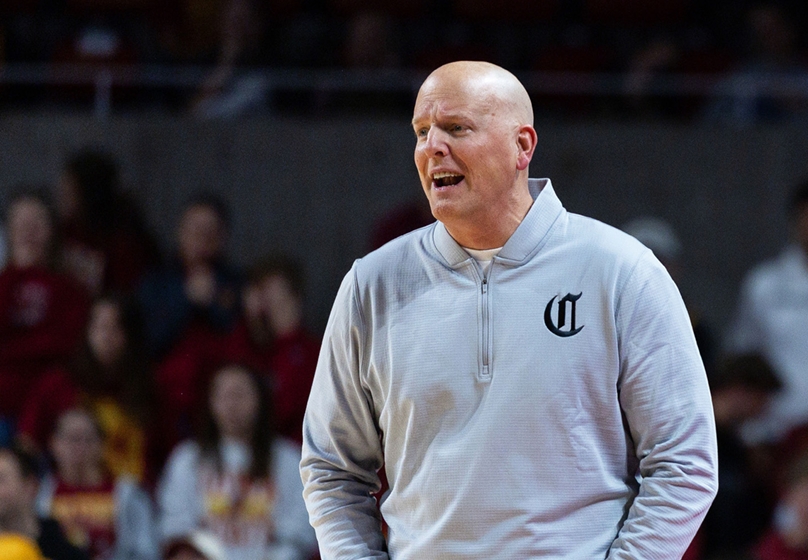
Creighton men’s basketball has spent months preparing for a new season, a new system and a roster featuring eight newcomers under first-year head coach Alan Huss. Two exhibition games offered the team’s first chance to see how that work translated against live competition.
Creighton defeated Iowa State 83-80 in Ames on Oct. 18 before outlasting Minnesota 89-86 in double overtime at home last Friday. In both games, the Bluejays built substantial leads before allowing their opponents back into contention.
Exhibitions give coaches room to experiment with personnel, test new schemes and see which parts of months of preparation hold up when the other team is working just as hard to disrupt them. For a Creighton team still learning to play together, those opportunities are particularly valuable.
“It’s really hard to simulate the game from practice. Everything we’ve worked on for the past six months comes to this point,” junior guard Austin Swartz said.
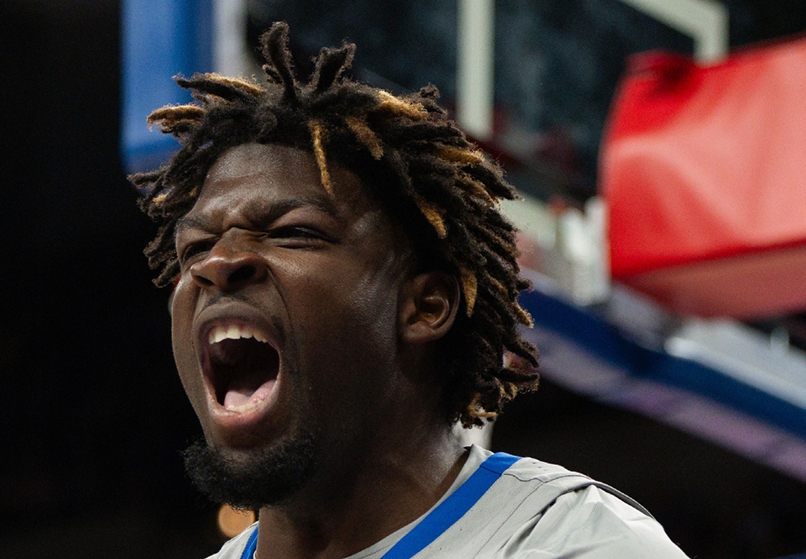
The Bluejays’ opening exhibition against Iowa State offered plenty of reasons for optimism. They made 14 of 29 3-point attempts, with Swartz and senior USF transfer Wes Enis each scoring 15 points. Freshman guard Katrelle Harmon led Creighton with 16 points in his unofficial collegiate debut, adding six assists, two blocks and two steals.
Harmon was productive on both ends of the floor, and his performance came amid a roster transition that will require contributions from players with different backgrounds and levels of experience. Creighton’s six transfers include Fredrick King, a familiar face returning to Omaha after spending his first three seasons at Creighton behind Ryan Kalkbrenner. The 6-foot-9 center transferred to Murray State for the 2025 season and returns to Creighton for his graduate year. The other newcomers include two true freshmen, Harmon and Trevon Carter-Givens.
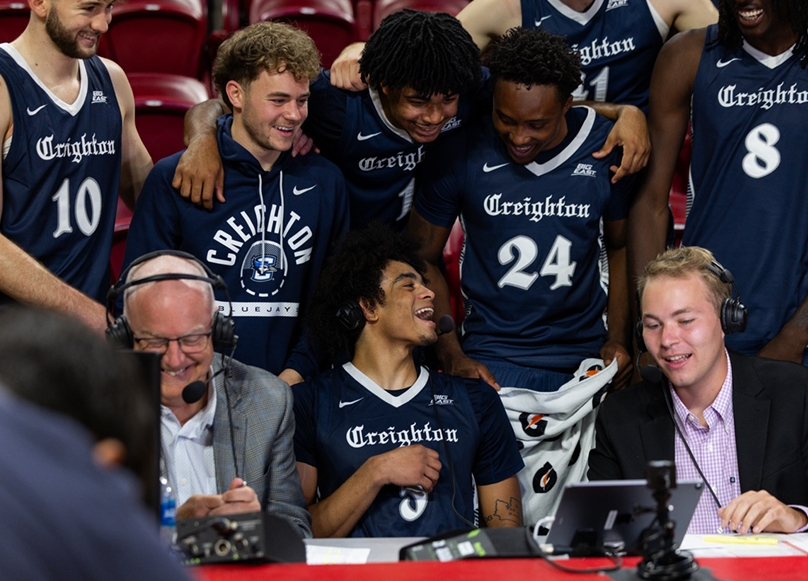
The team’s early chemistry was visible after the Iowa State game. As Harmon sat courtside for an ESPN interview, smiling beneath his headset, teammates gathered behind him with their arms draped over one another’s shoulders. It was a small moment, but a telling one for a group still building its identity.
The performance itself was less settled. Creighton led by as many as 19 points before Iowa State mounted a late rally. The Bluejays’ 3-point shooting had helped create the separation, but turnovers and defensive breakdowns gave the Cyclones a path back into the game. Huss pointed to Iowa State’s effectiveness in the pick-and-roll, particularly the space its offense created when the screener rolled toward the basket.
“They really picked us apart with the short roll … we did a better job of mixing pick and roll coverages late in the half to get us recalibrated defensively,” Huss said.
The adjustment helped Creighton regain its footing, but the broader challenge would follow the team to Omaha five days later.
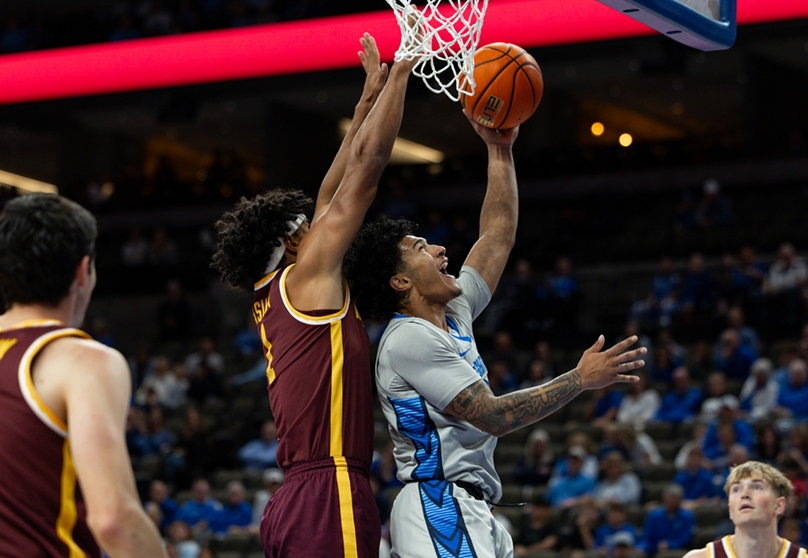
Against Minnesota, the Bluejays opened with an 11-0 run and led 44-31 at halftime. Their advantage grew to 18 points early in the second half, yet the offense gradually lost its rhythm. Creighton shot just 25% from the field after halftime, making seven of 28 attempts, including one of 13 from 3-point range.
Minnesota took its first lead, 65-64, with 1:19 remaining in regulation. The Gophers’ Isaac Asuma finished with 32 points, repeatedly finding ways to score as Creighton struggled to contain him. The Bluejays also had difficulty controlling the glass, finishing with 38 rebounds to Minnesota’s 58.
Swartz said the team needed to do a better job of creating opportunities for one another as the offense stalled.
“Whatever it is, we just have to have bodies moving, making plays: whether it’s for yourself or for somebody else,” Swartz said.
The junior guard also questioned how well Creighton had scouted Minnesota’s tendencies.
“I don’t think we did the best job today of knowing the other team,” Swartz said.
Creighton needed late contributions from players who had struggled earlier in the game. Enis, who went scoreless in the first half, finished with 20 points. In the first overtime, with the Bluejays trailing 76-73, he connected on a 3-pointer to tie the game and force a second extra period.
“I knew I had room to shoot it, and we’re down three, so I gotta let it fly,” Enis said.
Senior San Diego State transfer B.J. Davis scored 11 points across the two overtime periods, helping Creighton secure the win. The comeback prevented a disappointing finish, but it did not erase the problems that had made the extra periods necessary.
Those problems are especially relevant as Huss reshapes the team’s identity on both ends of the floor. After years of a controlled defensive approach under Greg McDermott, Creighton is moving toward a more aggressive system designed to force turnovers, disrupt passing lanes and pressure ball handlers. The old refrain that “Creighton doesn’t foul” may no longer be true. That aggression extends to defending screens, where the Bluejays must apply pressure and rotate quickly, rather than rely as heavily on drop coverage and the rim protection Kalkbrenner provided. Offensively, Huss emphasizes unselfish play in which players move the ball frequently, create opportunities for teammates and trust one another to make strategic choices.
Against Minnesota, Creighton forced 20 turnovers and converted them into 20 points. Those numbers showed the potential of the approach. But Minnesota also scored 36 points in the paint and collected 15 offensive rebounds, exposing the work still needed to protect the basket and finish defensive possessions.
“It’s clear why you play exhibition games: we had an opportunity tonight to show where we were, and we weren’t able to capitalize on that opportunity,” Huss said after the Minnesota game.
He had seen a similar pattern against Iowa State, when Creighton surrendered a 19-point lead. The problem, in his view, was not simply that opponents had made shots. It was that the Bluejays had strayed from the habits that helped them build their advantages in the first place.
“We deviated from [our] process both times,” he explained. “We had a chance to throw knockout punches in both cases, and we weren’t capable.”
That distinction helps explain why the locker room after Friday’s victory did not resemble the aftermath of a typical double-overtime win. Huss said he noticed disappointment among his players rather than the expectation of celebration.
“Of anything tonight, that’s what I’m most pleased with,” he said.
Davis said the team holds itself to a championship standard: one that requires players to accept responsibility for their mistakes and make sacrifices for one another.
“We all have to be willing to lean into that more and make sacrifices,” Davis said.
For a roster with so many new faces, establishing that kind of accountability will take time. The two exhibitions showed that Creighton can shoot well enough to create separation and force turnovers, but leads can disappear when the offense stops moving and defensive rotations break down.
“It’s a great lesson for what we’re capable of, and it’s a lesson of how small the margin of error in college basketball is,” Huss said.
The Bluejays officially kick off the Huss Era Monday at CHI Health Center. Tip-off against UMKC is set for 7 p.m.