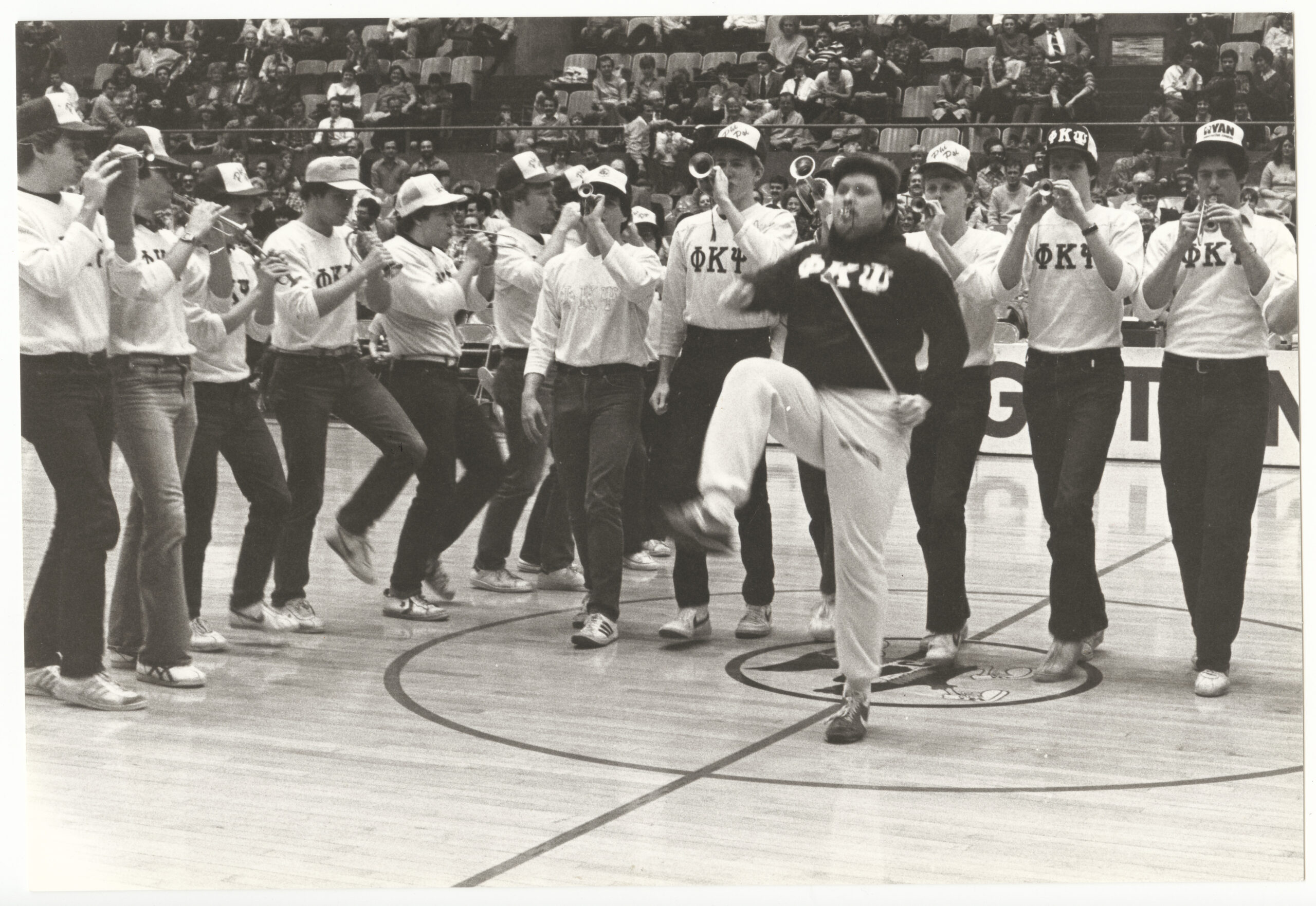
Two previously suspended fraternities will soon be returning to Creighton University’s campus: the Nebraska Beta Chapter of Phi Kappa Psi, which will return in fall 2026, and the Theta Lambda Chapter of Pi Kappa Alpha, which will return in 2028.
Enough time has passed that none of the people who were previously in either fraternity are still students on campus.
Their return comes as membership in Fraternity and Sorority Life (FSL) is growing at the university.
“Back when they were removed from campus, they had a contract saying they could come back after a certain amount of time. But it also coincided with [a time when] we were starting to look into growing the community because there’s a lot of growing interest in FSL at Creighton,” Katie Bodlack, the assistant director for FSL, said.
Once both organizations have returned, the number of fraternities a part of Creighton’s Interfraternity Council will be seven — up from the five fraternity chapters currently on campus — and the total number of FSL organizations at Creighton will be 25. The university’s FSL also has seven Divine Nine organizations, four multicultural organizations and seven Panhellenic Council sororities.
About 37% of Creighton’s undergraduate student body participates in FSL, according to the university’s website.
The Nebraska Beta Chapter of Phi Kappa Psi — set to return before Pi Kappa Alpha — was suspended by both the university and the Phi Kappa Psi National Headquarters in spring 2017 due to “violation of university policy,” according to the “Student Formation and Misconduct Processes” webpage on the university’s website.
The suspension followed an investigation that was launched after a pledge, Christopher Wheeler, attacked another student on campus. Wheeler then claimed substances in his system from hazing were the reason behind his actions.
“I wasn’t here during that time, but I know that’s what led to the investigation,” Bodlack said.
After Creighton suspended the chapter, the Phi Kappa Psi National Headquarters followed suit.
“In the spring of 2017, in response to Creighton University’s decision to suspend the chapter, the Phi Kappa Psi Executive Council revoked the charter of the chapter and ordered current members of Phi Kappa Psi to cease operations,” Benjamin Sigler, the senior director of chapter operations for Phi Kappa Psi, said in an email.
Wheeler, a 19-year-old premed student, was banned from campus in February 2017 after he entered another student’s dorm and cut her throat with a pocketknife, according to a 2017 article from KETV. The victim survived the attack but sustained injuries.
Wheeler, who could have faced up to 20 years in prison, took a plea deal and was sentenced to 30 days in prison and five years of probation, a 2018 WOWT article said. Wheeler alleged that he unknowingly cut the victim due to extreme intoxication after he was coerced into drinking alcohol and smoking marijuana during hazing, although a judge did not allow him to use that defense in court.
The victim went on to file a lawsuit against Phi Kappa Psi, and Wheeler was not listed as a defendant. The case was dismissed by a lower court, and the U.S. Court of Appeals for the Eighth Circuit affirmed that dismissal in a 2022 opinion.
According to the Eighth Circuit’s opinion, the lawsuit stated that the Nebraska Beta Chapter of Phi Kappa Psi was already on social probation from the university at the time of the incident because they had “violated multiple provisions of Creighton Student Conduct policy, Creighton Greek Event Guidelines and State Law.” It went on to claim that the chapter’s 2017 initiation activities violated the terms of their social probation.
“These activities included ‘multiple occasions of forced drinking, drinking games, providing alcohol to minors, going to local bars and encouraging alcohol consumption by pledges [i.e., recruits who accepted the bid,] to the point of vomiting and/or blacking out.’ Wheeler, an underage student, was among the pledges required to participate in these activities,” the Eighth Circuit’s opinion said.
The lawsuit alleged that the hazing was an issue with this fraternity on a national level.
“Initiation activities began on January 30, 2017, and lasted about a week. This week was widely known as ‘Hell Week’ within the Chapter,” the Eighth Circuit’s opinion said. “[The victim] alleged that the initiation activities were ‘expressly directed by the National Fraternity’ and included, but were not limited to, a slave auction, surrendering one’s cell phone, keeping all activities secret, minors consuming alcohol at the Chapter House, forced consumption of alcohol by minors to the point of vomiting and/or loss of consciousness, and withholding food and/or water.”
Also according to the court’s opinion, Wheeler was required to pass a test about the chapter and the National Fraternity. After he failed, he was allowed to re-test the next week; and after his re-test, he was taken to the fraternity-owned house (which has since been demolished) and given alcohol and marijuana. He was then left alone on Creighton’s campus, which is when he entered another student’s dorm and attacked her. Wheeler and the student did not know each other.
“Witnesses who knew Wheeler and allegedly saw him on campus that early morning described Wheeler as confused, out of character, and, at times, belligerent,” the Eighth Circuit’s opinion said.
The lawsuit was ultimately dismissed because the court found no violation of state law.
“At some level of generality, it is foreseeable that a black-out drunk, underage college student who was hazed and harassed for a week, abandoned on campus during the early morning, and considered disoriented and belligerent could harm himself or others. But Nebraska’s foreseeability pleading requirements require more than generality — specificity is required,” the Eighth Circuit’s opinion said.
Creighton was not involved in this lawsuit.
“I’m getting caught up on everything, but … I think all the court cases were handled. They weren’t university court cases,” Bodlack said.
The process of bringing Phi Kappa Psi back to campus is already underway. Last week members of the National Headquarters visited campus to meet with student leaders, Bodlack said.
“The Phi Kappa Psi Fraternity strives to be a strong partner with Creighton University by providing a unique student experience that fosters personal growth, leadership and a sense of community. With our return to Creighton, we aim to create an environment where students can thrive and make a lasting impact on their peers and the broader university community,” Sigler said via email.
Representatives from the fraternity will come back in the fall to recruit the founding father’s class, and a staff member will be living in Omaha to oversee the transition. According to Sigler, they’re looking for students who embody leadership, academic excellence, community service and a desire to positively impact Creighton.
Bodlack said the reinstatement of the Theta Lambda Chapter of Pi Kappa Alpha in 2028, likely in the spring, will be done similarly.
The chapter was suspended by the university in spring 2019 “after the fraternity violated the terms of its Social and Behavioral Probation,” according to the “Student Formation and Misconduct Processes” webpage on the university’s website.
Prior to this 2019 suspension, they had been suspended by the university in 2012 and reinstated in 2016, according to a 2016 Creightonian article. A 2012 Creightonian article said they were suspended following violations of university policy in alcohol-related incidents.
Bodlack is not concerned that being suspended and then reinstated will become a continuous pattern for the chapter.
“I wasn’t here during that time, so I didn’t see what happened then [during their previous suspensions]. But it’s going to be all new people, so I think that’s the big difference. … There’s also just a really strong commitment in the overall fraternity and sorority community of having strong risk management systems,” Bodlack said. “So, we really want to set up the organizations for success. Obviously, we don’t want any chapter on campus to have a negative perception or people not having a safe experience. So, as a community, we’re really committed to ensuring that this group does have success and is set up from the ground up with a really strong risk management.”
Bodlack also said that, since these two fraternity chapters were suspended from campus, Creighton has done a lot to prevent hazing. Additionally, she said the university is required to comply with the Stop Campus Hazing Act. Passed in December 2024, this federal law is an amendment to the Jeanne Clery Campus Safety Act and requires institutions of higher education that participate in federal student aid programs to report hazing incidents. At the state level, hazing is also a Class II misdemeanor under Nebraska Revised Statute 28-311.06.
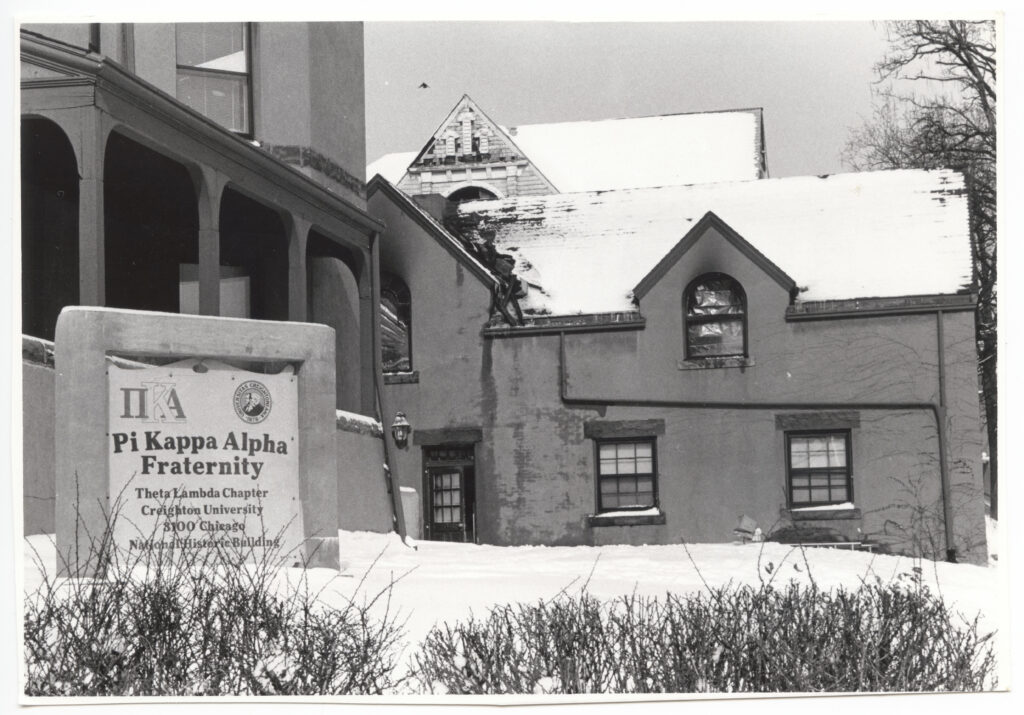
PHOTO COURTESY OF THE UNIVERSITY ARCHIVES AND SPECIAL COLLECTIONS
“I’m really proud of all the work that we’ve done to make this a campus culture that doesn’t accept hazing,” Bodlack said.
Anti-hazing initiatives include new member education, which is required for everyone who joins FSL and covers topics including drug and alcohol safety and hazing prevention. Creighton also hosts a hazing prevention week each fall and has started bringing in anti-hazing speakers in the spring. Last spring speakers from “Love, Mom and Dad,” a program run by the Hazing Prevention Network for parents to share stories about how hazing has impacted their families, came to the university.
“We have multiple different points throughout the semester that we do education on it [hazing prevention],” Bodlack said. “And I’d say overall that we’ve established a culture that if someone sees something, they say something and [hazing] is not accepted in our community.”
A new webpage, “Creighton Anti-Hazing Policy,” launched on Creighton’s website during winter break. The webpage has space to report an incident and make an anonymous report. It also outlines Creighton’s policy, defines hazing and offers additional resources for reporting hazing incidents in other ways, including the phone number for the Anti-Hazing Hotline. Furthermore, the “Campus Hazing Transparency Report” linked on the webpage shows whether hazing was reported on campus dating back to the 2021-2022 academic year (only one incident, during 2022-2023, has been reported since that time).
Bodlack doesn’t think that bringing back these fraternities will bring back hazing.
“I think it’s [their return] a really exciting opportunity for the campus. I know there’s a history with both organizations, but we’re a couple of years out from that. It’s a new group of people, and I’m confident that our students are going to have a really positive experience with these organizations,” she said. “We’re working really closely with their headquarters, too, on their establishment and creating strong organizations. So, I’m excited for more of our students to get to meet them.”
She added that students will have more opportunities to interact with Phi Kappa Psi in the fall when they begin recruiting and hosting events on campus.