Janna Lopez becomes first inaugural poet-in-residence
Poetry is a powerful language. It allows the smallest to be seen. It allows the silenced to be heard. It allows the fastest to catch their breath. Poetry is a powerful language that allows us to empathize with others. It allows us to think through the mind of another. It allows us to see through the eyes of another. It allows us to feel through the heart of another. Poetry is a powerful language that allows us to empathize with others and transform ourselves.
-Shelby Seu
In June of 2025, Creighton University’s School of Medicine inaugurated Janna Lopez, MFA, as its first ever inaugural poet-in-residence for their Medical Humanities curriculum. According to John A. Creighton University professor and chair of the department of medical humanities, the Rev. Kevin FitzGerald, S.J., Lopez was the missing piece to the curriculum, as her insights could allow for upcoming physicians to empathize with their patients on a deeper level and transform their care into one that can nurture their patients’ bodies and spirits.
“[The role of the inaugural poet-in-residence is] to employ the style and methods of poetry and poetic expression to facilitate healthcare student and faculty reflection on their experiences with their patients, other professionals and themselves in order to foster deeper, richer and more meaningful connections among themselves and their patients resulting in improved patient outcomes and more fulfilling healthcare careers for them,” FitzGerald said via email.
According to Lopez, the process of her hiring was not through a traditional application, but a conversation between her and FitzGerald. Upon reflection, both Creighton and its School of Medicine recognized that poetry was a necessary practice crucial for nurturing the physicians of tomorrow.
“It was mostly serendipity. … I met Fr. FitzGerald, and we talked a lot about the philosophy of Creighton and the medical humanities. I told him my approach and my work and so he had told me that he felt poetry was the missing puzzle piece and so I proposed, ‘How about doing a position that we can call a poet-in-residence that helps build poetry into the curriculum and to integrate it into everyday life with the students and the faculty?’” Lopez said.
For her entire life, she has always written poems as a means to help her understand the world around her. However, it wasn’t until Lopez was 48 that she began to consider herself a poet. In fact, Lopez didn’t read poetry until she was in her early 50s.
“It was because I was so intimidated. I always felt very incompetent and not as smart as or not as educated as most people, and it [poetry] was so pedestaled that I felt like it belonged to everybody else but me. And so, I didn’t approach reading poetry until I was in my graduate creative writing program, getting my MFA,” Lopez said.
Yet, it was her delayed entrance into the field of poetry that allowed her to derive her mission of helping others see past similar worries and indulge in a practice that can uniquely transform the way one expresses themselves.
“And it’s because I’m such a late bloomer, meaning I’ve written it my whole life and never called myself a poet and didn’t read poetry until I was in my early 50s, that I feel like it’s such a shame that people have those beliefs. And so, that is why I’m so committed to helping people [see] that it’s never too late. … It’s the hidden in plain sight superpower and, with a little bit of love, guidance and support, it can become the thing that completely electrifies your experience of expression and creation.”
In her role at Creighton’s medical school, Lopez has been hosting one-on-one workshops with students and faculty members to guide them in different poetry writing activities. According to her, these exercises are meant to introduce poetry in a low-stakes manner that sparks a continued curiosity from the poetry created during the session.
“It’s more of a qualitative endeavor. … I’d rather have two hours or one hour with a student or a faculty member than 20 minutes with a hundred because it does take work. This is not something that is a quick fix,” Lopez said. “It’s a life-changing transformative endeavor. So, I’m still figuring out how to meet students where they are, and I believe that poetry could be more integrated into Creighton in an everyday way.”
Lopez also recognizes that writing poetry is no easy feat, especially for those in the medical field where stylistic writing is not practiced frequently. However, she believes that poetry can better the well-being of the provider and, in turn, better the well-being of the patient.
“I think, if we’re taking care of our providers, and the providers are taking care of themselves, they’re going to have more capacity to take care of everybody else. I mean physician burnout is amongst the highest even comparatively to first responders. … What I’ve learned is they’re so self-sacrificial, they don’t recognize how to care for themselves, which is interesting, because they’re caring for others,” Lopez said.
She also believes that poetry can enhance a physician’s ability to handle difficult topics or events by providing them with a means to better understand their emotions during the circumstances their careers come with.
“Poetry helps people process deeply contradictory emotions. … In medicine, we’re asked to give compassion and hold space for people in the most difficult transitionary moments of their lives, and we want them to feel heard and seen and to extend empathy. And in order to do that, we need to, as medical providers, provide that for ourselves. Physicians … are very research driven. They forget that being with people is an act of creative connection. So, it helps remind the physicians of the power of humanness and a capacity to reflect and to be able to just be present for the very contradictory lives that we actually live,” Lopez said.
Through the example set forth by her poem “How to Bury a Dead Bird in Winter with Honor,” Lopez believes that poems come in many shapes and forms. She advises those beginning to enter the realm of poetry to start simply by engaging in poetic intelligence — to observe one’s surroundings with a sense of curiosity that allows for creative interpretation that feels right to them.
“I don’t understand every poem, but if I’m being patient, and going through the poetic intelligence method, I can learn to see things that weren’t immediately visible. So, I believe that we have it within us. … Poetry, to me, is everywhere and everything. Everything can have a poem. Everything can fulfill a poem,” Lopez said.
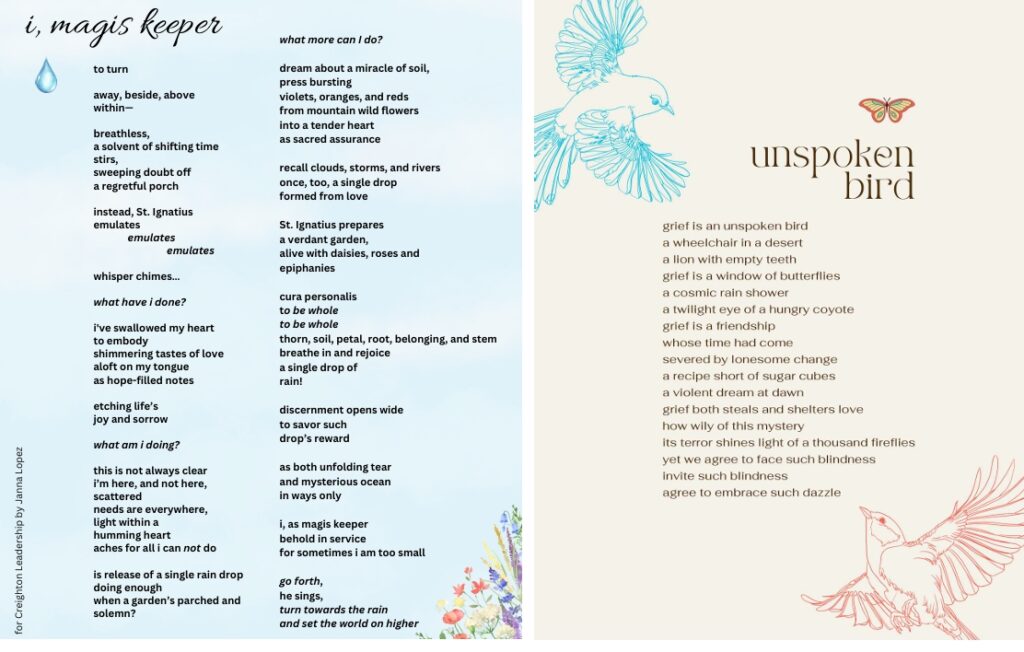
PHOTOS COURTESY OF JANNA LOPEZ