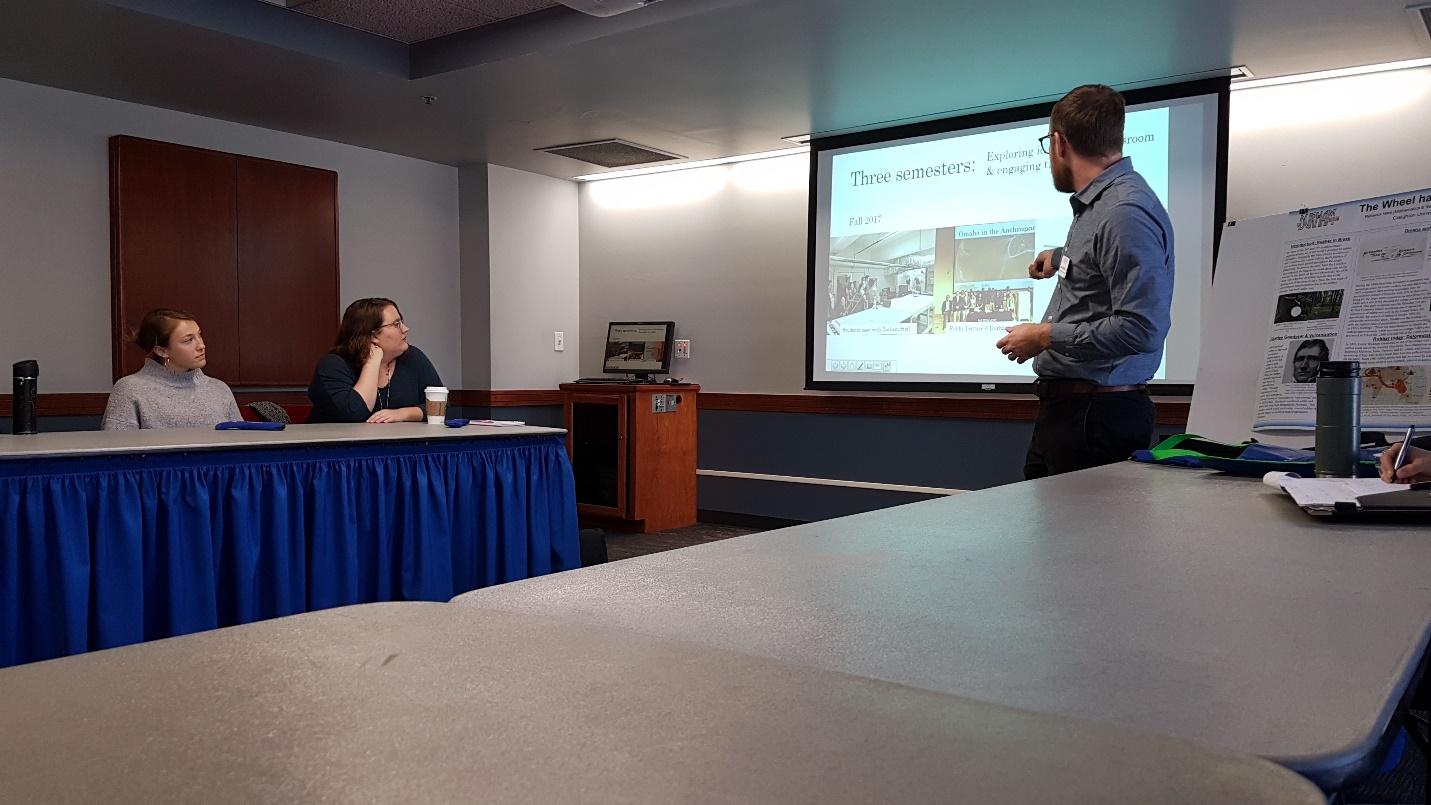
Creighton’s Office of Sustainability Programs held a Sustainability Forum on Tuesday afternoon. The forum, entitled “Curating the Earth System: Building an Interdisciplinary Public History Exhibit on the Anthropocene,” discussed the emergence of a new geological epoch being considered called the Anthropocene and how Creighton students’ research on the topic is being presented at The Durham Museum in Omaha.
The Anthropocene, as described by Assistant Professor Dr. Adam Sundberg, is the new proposed geological epoch that is defined by one thing: humans. In his presentation, Sundberg explained that according to supporters of the Anthropocene idea, people have become “a force of global geophysical significance.”
Research into the Anthropocene is being done through an environmental science and history intersections course led by Sundberg entitled Global Environmental History. The class seeks to understand what humanity’s role has been in changing the face of the earth and how the environment has shaped human history on a local and global scale.
For the past three semesters, the class has partnered with The Durham Museum to research and present their findings. Each student in the class selects an artifact from the museum to research which may include coffee cans, rubber and concrete.
The fall of 2017 class’s work went on display at the Durham Museum in March 2018 and will be exhibited until March 2019. Subsequent classes’ work is publicly presented at the museum and have their own online exhibits.
Speaking about the benefits of the class, Sundberg said, “For students, for myself, and also for the public, it’s a reminder that everyday objects, mundane objects … tell a globally significant, environmental story.”
The Durham Museum has received national recognition from the American Alliance of Museums for the exhibit done by Creighton students. The exhibit was also cited in a scholarly journal and according to Emma Sundberg, Curator of Collection at The Durham Museum, has received very positive feedback from the public.
Sundberg emphasized the uniqueness of the class’s research and said that though many organizations have presented exhibits on the topic of the Anthropocene, “none of them draw on undergraduate research, much less multidisciplinary undergraduate student research.”
“This link between Omaha and global history, this is also unique. None of these other exhibits, none that I’d ever heard of, attempt to tell the Anthropocene story from a local historical perspective.”
One of the students who took the class, Rebecca Hare, a senior in the College of Arts and Sciences, presented her research into the impact of rubber on the environment at the forum and spoke about how the class has affected her. “It definitely is a conversation to have as college students because so many people go through their lives just going through the motions and never being fully aware. But this class definitely brought a more real perspective on the Earth and how I’m impacting it.”