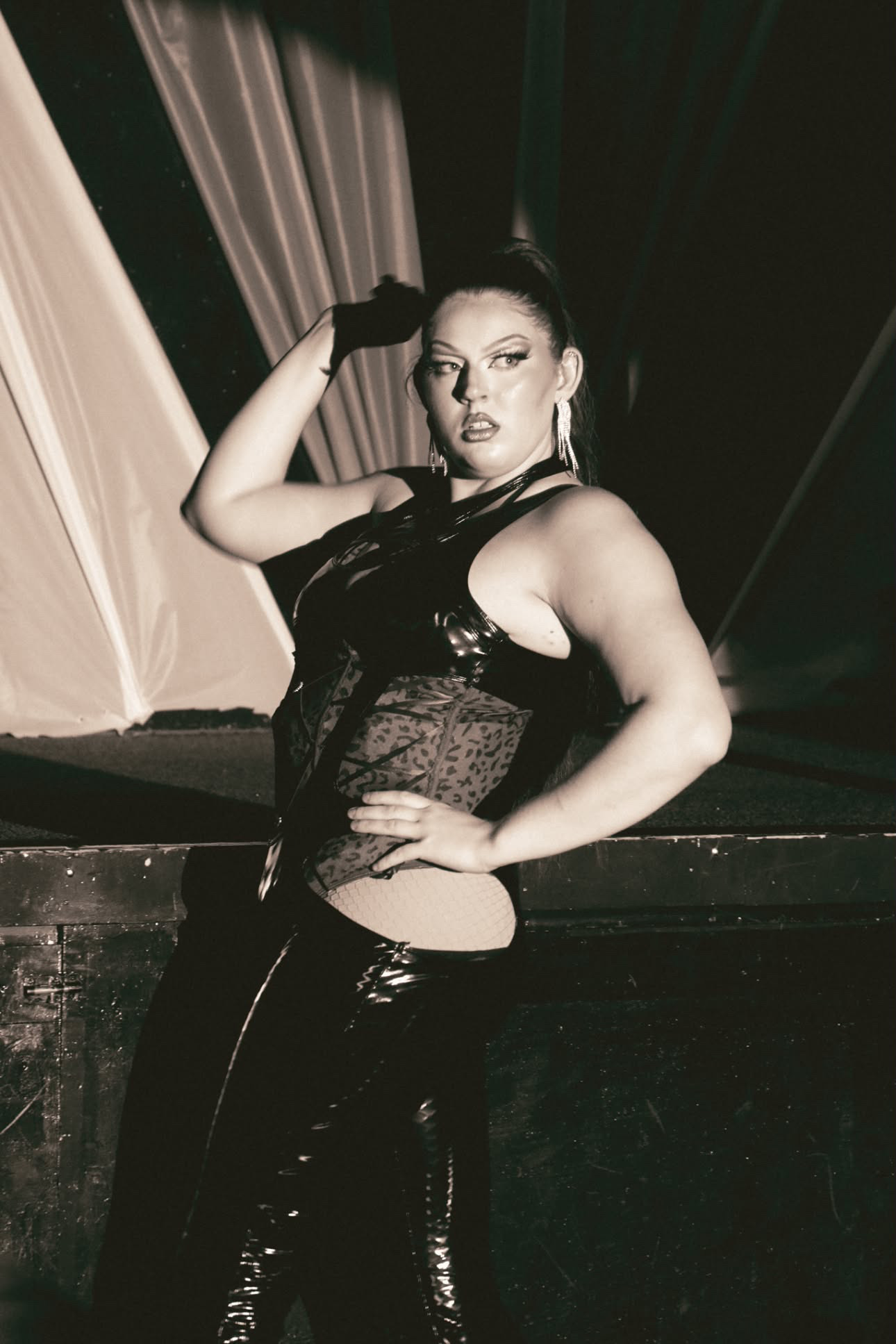
PHOTO COURTESY OF CARLY FROLIO
By day, Emily Stover is a College of Arts and Sciences senior majoring in psychology and musical theater; juggling classes, rehearsals and campus leadership roles. By night, she’s Camry Cosette — sequined, crowned and building a name for herself in Omaha’s drag scene.
Stover started performing in drag less than a year ago. Now she balances a full course load, multiple campus leadership roles and a growing drag career that has taken her across Nebraska and Iowa.
“It’s kind of that same thing where it helps me have an outlet outside of school,” Stover said, comparing drag to the role theater played for her earlier in college. “But that also still aids what I want to do in the future.”
Stover’s introduction to drag came through her love of watching “RuPaul’s Drag Race” and theater. While working backstage on “The Rocky Horror Show” at Bellevue Little Theater, she met local drag performer Ryan, known onstage as Cherry Peaks, who would go on to become her drag mom. The two bonded over makeup, and Cherry Peaks invited her to watch her shows before encouraging Stover to try an open stage, an event where anyone can sign up to perform.
She lent her a costume, and Stover styled her own wig and did her own makeup for her first performance last November, placing in the top two with a mashup of Charli XCX and Rebecca Black.
Stover’s drag name, Camry Cosette, combines a nod to her car — she crashed her Toyota Camry — with a reference to the “Les Misérables” character Cosette. This past weekend, she won a lip sync competition called Drag Roulette, and one of the competition’s organizers invited her to join the Haus of Deveaux, a mentorship network built on a long line of local performers. Stover said several members of the house have been among her favorite local performers for years, and she’d looked up to them long before joining.
“I didn’t want to take it off,” Stover said of the crown she won at the lip-sync competition. “It’s so perfect to me.”
Stylistically, Stover said her performances lean toward the theatrical and celebrate feminine power.
“I love doing very theatrical musical theater numbers,” she said. “But I think also just celebrating especially queer artists and songs made for women — that’s kind of my niche.”
Stover said her friends, many of whom are involved in Creighton theater, were quick to support her new pursuit. Her family took longer to understand it — until they watched her perform at a drag brunch.
“It was very meaningful because it showed that even if they don’t get it, they care, and they see that it’s something that is really special to me,” Stover said.
Performing has also reshaped how Stover thinks about gender expression.
“I didn’t know that even being born female, that it was an option,” she said. “Drag is a lot of character and performing, making things bigger than life and crafting it into how you want to see yourself and entertain others.”
Makeup has become one of the most personal parts of performing, giving Stover “a chance to learn tips from other people and feed off other people’s art. I never felt creative with fashion until I did it.”
One keepsake from her first year performing still means the most to her: a pair of white heeled go-go boots she wore during her first open stage. Her drag mother eventually told her to retire them.
“She said, ‘Please don’t wear those white go-go boots anymore,’ so I said I threw them away,” Stover said. “But my biggest secret is they’re still in my closet.”
Amy Lane, associate chair of fine and performing arts and director of theater and musical theater at Creighton, first got to know Stover as a performer in her Theater for Social Justice class last spring, in which students research and advocate for a social issue through a final performance. Stover chose drag.
“Let me show you why drag is such a positive force in our society,” Lane said, describing Stover’s pitch for the project, which included a classroom demonstration of drag makeup and a short film about her life as a performer.
“We all learned a lot, and we all saw how important it was to her in her personal life, but [also] how it creates a sense of community,” Lane said.
She added that the project also pushed back on claims that drag performance is harmful to children.
“None of it is true,” Lane said. “I think it shows children that there is love, that there is fun, that there is community and that all children are okay exactly the way they are, however they are.”
Lane, who said she had not previously met a cisgender woman performing as a drag queen, called Stover’s presence in the scene an expansion of what drag can represent — and “a great representative of the drag community.”
One of Stover’s psychology professors, Jill Brown, has taught at Creighton for nearly two decades. Brown teaches Psychology of Gender, an elective examining gender socialization, gender essentialism and identities beyond the binary — and allows students to attend a live drag performance for extra credit.
“Taking something like drag and really understanding it on a different level is helpful in so many ways,” Brown said, adding that the assignment consistently changes how students see the community. “Once you go to a drag performance, a lot of stereotypes are shattered. You actually see trans joy; you see the profound kind of radical authenticity that people have.”
Brown pointed to Stover as an example of drag’s evolving reach, describing her participation as part of a broader shift she called “fourth-wave feminism” — a movement, Brown said, defined by expanding who gets included in feminist spaces.
“It just feels so beautiful sometimes to break barriers,” Brown said, “to realize that we’re actually connected in ways we don’t always think we are.”
Brown said she hopes students who attend a show — or readers who’ve never been to one — come away with more information, not less, pointing to research linking rigid gender essentialism to hostile sexism.
Stover said drag carries a political weight rooted in its origins.
“It was built out of rejection of the norm,” she said. “So of course it’s going to be political.”
She pushed back on the assumption that drag is inherently sexual or unsuitable for younger audiences, pointing to all-ages drag brunches as evidence the art form can reach broad audiences.
Stover was blunt about why she thinks visibility matters on Creighton’s campus specifically.
“God forbid there’s gay people on this campus,” she said, laughing. “Somebody’s got to say it.”
Stover performs regularly at Flixx, a cabaret and show bar in Omaha, as well as The Sydney in Benson and The Highball Bar in Lincoln, where she is producing her first show in November.
For Stover, the Omaha drag community — both performers and audiences — has become something much bigger than a hobby.
“It means so much to me because they make me feel supported, loved and able to be unapologetically me,” she said.
That sense of community is the most present backstage, she said.
“It also is fun because I love a dressing room environment. It’s always so fun to be in a dressing room and joke around and hang with your friends and have people who are also in the same place as you all the time. So, you get to connect over the people you see and the things you do. And also, just the culture of this — being around a ton of people who are queer, who are gender nonconforming. It’s always so cool because you can really be whoever you want to be in that space.”
Getting ready for shows has become one of her favorite parts of the process.
“It gives you a chance to really just make yourself look like how you feel inside,” Stover said.