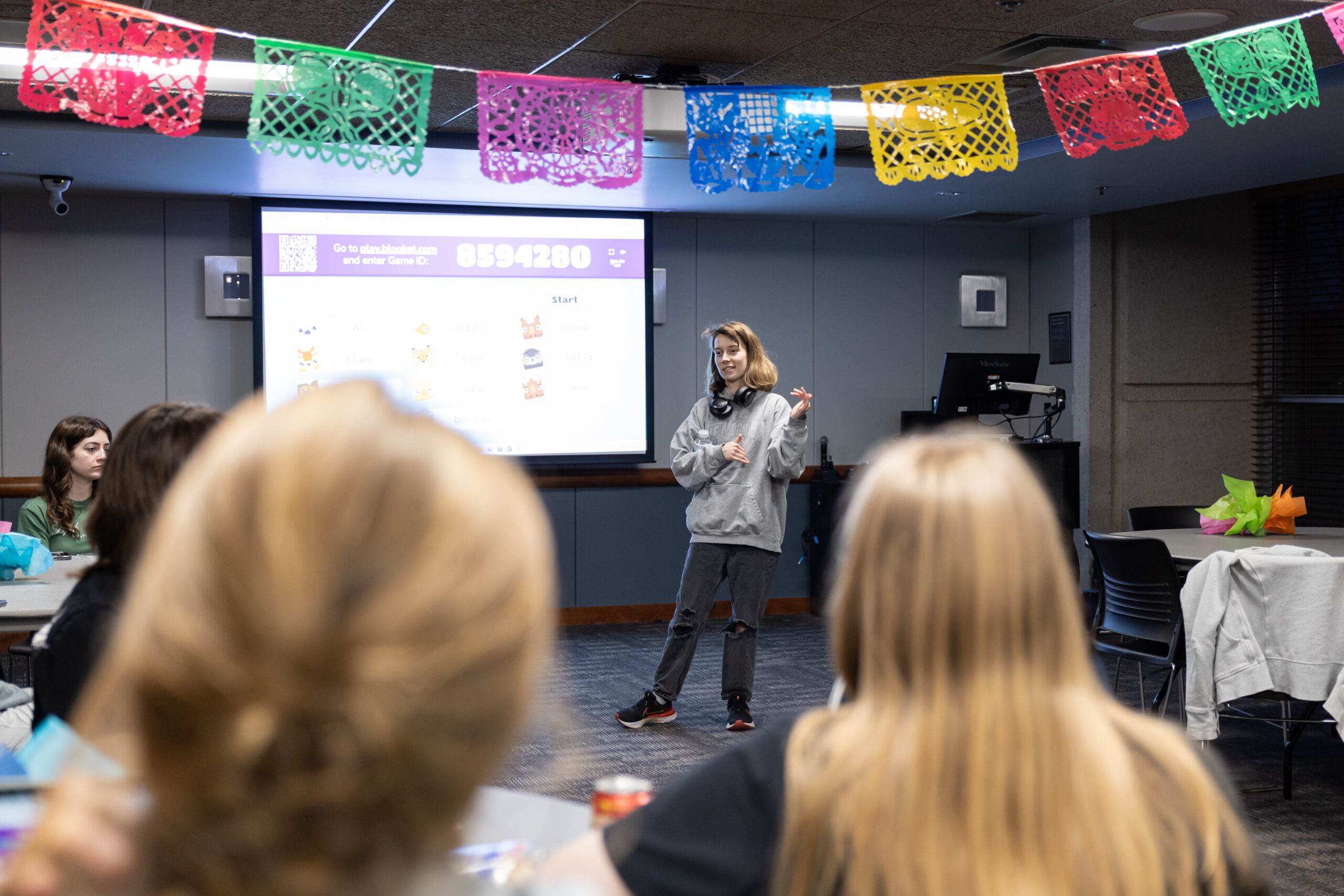
Creighton students were invited to learn about the importance of culture at “Celebración de Carnaval” through games, community, and snacks provided by Creighton’s Club del Español.
Last Monday, Feb. 16, Creighton’s Club del Español granted the opportunity for its members and students to learn more about Hispanic culture, specifically in Latin American countries, through the commemoration of the celebración del Caranaval. To cultivate a lively atmosphere, the event featured authentic treats and snacks from local Hispanic businesses such as the International Bakery and Supermercado Nuestra Familia, as well as festive music and bright decorations. Matters began with a short presentation regarding the origins of Carnaval and how it is recognized in various Hispanic countries, highlighting the ways in which indigenous and African culture have contributed to the ongoing diversity.
This was followed by an educational trivia game which allowed students to test their knowledge and embrace some friendly competition. Through these activities, participants were encouraged to engage in meaningful conversations, while also partaking in the offered festivities.
Celebración de Carnaval, otherwise known as Carnival, begins on Quinquagesima Sunday (the Sunday before Ash Wednesday) and concludes two days later, signifying the commencement of the Lenten season. Its origins can be traced back to ancient Egyptian, Greek and Roman civilizations, which held feasts and parades to welcome the arrival of spring and honor their gods. Over time, other African and Indigenous cultures incorporated their own traditional and musical aspects, such as burning sugar cane, stick-fighting and the use of pan steel drums, to further enrich activities and honor their heritage.
As Christianity and Catholicism spread across the globe due to colonization, church authorities adapted many of these revelries to precede Lent, the forty-day period leading up to Easter, which is typically characterized by periods of fasting and various penitential practices. Such jubilant attitudes and behaviors are directly displayed on the final day of the Carnival season: Mardi Gras. Also referred to as “Fat Tuesday,” these twenty-four hours are filled with grand parades, indulging in rich foods and cheery social gatherings as a means of celebration.
In Latin America, each country has developed their own traditions, incorporating regional identity and pride into their recreations to display community spirit, creativity and acknowledge national history.
Such social awareness is ultimately what Club del Español sought to promote by hosting this event.
“The Creighton Spanish club is not only a language club,” explained junior Jarrod Choate, who is the current president of the club.
“We’re also a cultural club, so we want to learn about Hispanic culture and how it’s celebrated throughout the world … It’s also really good to bring cultural events from all different parts of the world to the Creighton campus, so that we can learn a little bit more about things or experiences that are different from our own,” Choate said.
Similar sentiments were echoed by junior RJ Stefka, who recently studied abroad in the Dominican Republic, claiming that the opportunity for social and cultural engagement was one of the reasons why he decided to attend the Carnival event.
“If you see other people’s cultures … it changes your mindset to the point where you can see things from a broader perspective,” he said. “I think that if you have that perspective, then you can see life a little bit more clearly, and honestly it makes me happier …”
Though direct involvement is a great way to gain new experiences and connect with individuals of different backgrounds, it’s important to remember that culture and language go hand-in hand. Recent estimates show that under 20% of the world population speaks English as their native or second language, which rounds out to around 1.5 billion people or four out of five people. These facts are why it’s essential to consider multiple sociocultural factors when interacting with strangers or traveling to new places.
Annie Sanden, the tutoring coordinator of the Spanish Club and a junior, explains that Club del Español has attempted to apply this mindset through Carnaval, other related events, and their weekly drop-in tutoring.
“Culture is very much tied with language, so that’s why the Spanish club also wants to focus on cultural events as well, because language influences culture and culture influences language.”
Overall, she encourages anyone who is interested to join, since “… learning a new language is about learning new things and meeting new people. So that should be, first and foremost, what you do.”