CHAD ROHRER/THE CREIGHTONIAN
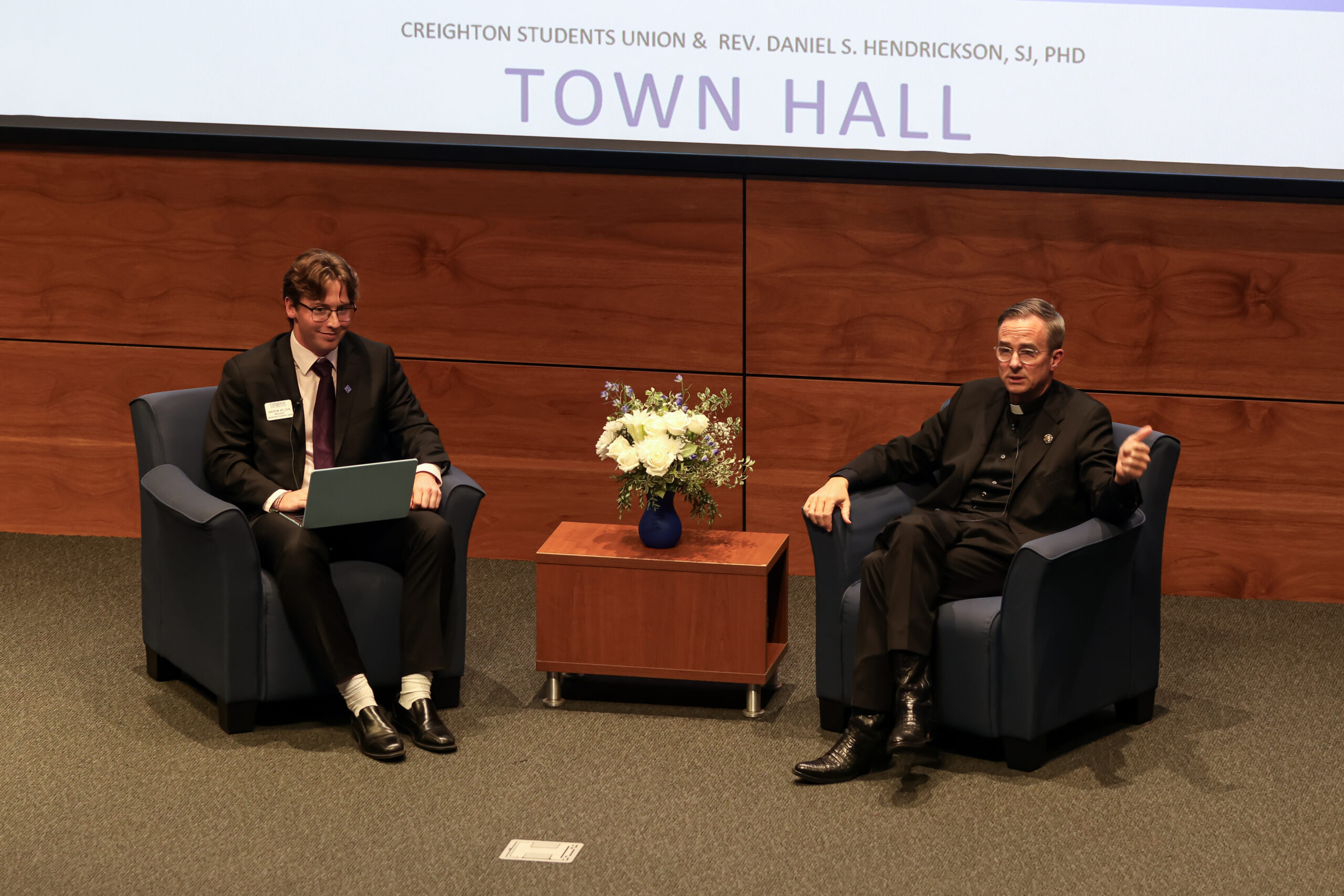
CSU President Andrew Nelson leads a Q&A with Fr. Daniel Hendrickson during the town hall.
Creighton University President the Rev. Daniel S. Hendrickson, S.J., Ph.D., discussed the university’s enrollment growth, campus development projects and future priorities during a town hall hosted by the Creighton Students Union on Wednesday, Nov. 11, in the Harper Center.
Hendrickson began by highlighting the university’s enrollment, noting that Creighton had reached its largest overall enrollment to date. The Omaha campus has nearly 8,000 students, while the Phoenix campus has approximately 1,000 students and is at full capacity.
“We’re just thrilled that Creighton continues to be a real source of attraction to folks like you who add so much to this community year in and year out,” Hendrickson said.
He also discussed the university’s continuing education programs, which offer professional badges, credentials and opportunities for those looking to develop new skills. Although the College of Professional and Continuing Education has a smaller traditional degree enrollment, Hendrickson said it has more than 6,000 additional engagements through these programs.
“Sometimes people need to reskill or upskill or just keep moving on in their careers in different ways,” he said.
Hendrickson then moved into Creighton’s campus master plan, which began shortly after he became president in 2015. He said the university started by examining how campus functions and what students need for learning and living.
The university has relocated much of its student housing toward the center of campus, with approximately 1,300 students now living in the area. Graves Hall opened three years ago, followed by Magis Hall this year. Hendrickson also discussed plans to bring intramural sports, recreation and athletics together in a central recreation corridor.
“We started almost immediately just thinking about how does this campus function? What do the students want and need for learning and living?” Hendrickson said.
He reviewed several projects completed during his presidency, including the Werner Center for Health Sciences, the School of Dentistry, the pedestrian bridge and improvements to 24th Street. He also highlighted the redevelopment of the former university hospital property, which was reportedly sold for $1 and redeveloped by Atlas Partners through a $110 million investment.
Hendrickson said the redesign of 24th Street was intended to make the area more recognizable as part of Creighton’s campus. He also highlighted improvements to campus housing, the Jesuit residence, the campus fountain and athletic facilities.
One of the newest additions to Creighton’s campus, the Creighton Quad, opened the following day, Nov. 12. Hendrickson said the project was designed to give students more green space and a place to gather. It also serves to advocate for the campus sustainability values, with 189 new trees.
The presentation then shifted toward future infrastructure plans. Hendrickson said the university received approximately 11 blocks of Burt Street from the city of Omaha and is working on financing to transform the area into a greenway with a bike path connecting campus to downtown.
“We asked the mayor, we said, ‘Mayor, we own both sides of Burt Street,’” Hendrickson said. “We’d like to either vacate Burt Street to Creighton and give Creighton the ownership of the rights of Burt Street, and we don’t want to pay for it. We’d like it as a gift. And they did [give it to us as a gift].”
The university is also considering improvements to 19th and 20th streets, including updated sidewalks and pedestrian features. Hendrickson presented additional possibilities for campus dining, including whether to combine two dining locations into one larger facility. A next-generation library and a new fitness center are also being considered.
Hendrickson then discussed development happening east of campus in the Builders District. He said developers have promised a Trader Joe’s location, although the project has taken longer than expected.
“I announced to the public and staff like three years ago we’re getting a Trader Joe’s. It’s not here yet,” Hendrickson said.
He joked that he has to apologize for the store’s continued absence each year, adding, “We’re working on it.”
He also pointed to a proposed Marriott Tribute Hotel in the district, which he said could serve students’ families, prospective students, visitors and Creighton’s athletic programs.
Additional athletic facilities are under construction on campus. Hendrickson showed plans for a baseball and softball operations facility that will include locker rooms, offices, conference rooms and batting cages. He also discussed a separate facility intended to serve approximately 300 Division I student-athletes, excluding men’s basketball, which already has its own building. The facility will provide resources for nutrition, weight training, academic support and other services.
“We’re excited to get this up and standing,” he said.
Hendrickson next addressed Creighton’s sustainability efforts, including solar panels, geothermal wells, electric vehicle charging stations and the university’s J-Pass program, which allows students to ride Omaha Metro buses at no additional cost.
“I’m all in on sustainability, sustainability and energy conservation and issues related to that,” Hendrickson said.
He also discussed the university’s partnership with Cordia on a chilled-water system, which he said helps reduce carbon emissions by approximately 50% in participating buildings. Hendrickson acknowledged that although the university has made progress, more work remains.
“We’re exceeding our targets. We’re not at the aspirational levels,” he said. “So, we have a bit of work to do with the university to get to that.”
The presentation then turned to academic programs and university initiatives. Hendrickson highlighted the Institute for Adaptive Intelligence, announced the previous spring, which is intended to help students understand artificial intelligence and prepare to use it in their careers.
He said Creighton also has a responsibility to address the ethical questions surrounding the technology.
“We are Jesuit Catholic and we need to ask the important questions, the ethical issues, the other inquiries, the guardrails of AI so it doesn’t exploit you or us or people anywhere,” Hendrickson said.
Other programs highlighted included the Bright Center for Enterprise Value, Career Personalization Services, undergraduate research opportunities, legal clinics and the Kamen Center for International Criminal Justice and Holocaust Studies. Hendrickson said more than 1,000 students had already used Career Personalization Services during the fall semester.
He also discussed the university’s fundraising and global initiatives. Hendrickson said Creighton raised approximately $270 million for scholarships over the course of a decade-long campaign. He highlighted the Global Initiative, which has supported approximately 117 projects and involved about 1,500 faculty, staff and students.
Following the presentation, student body President Andrew Nelson moderated a question-and-answer session with Hendrickson.
Students first raised questions about campus buildings that are no longer in use, including Deglman Hall. Hendrickson said the university has not made a final decision about the building’s future. Options include demolishing it, repurposing the space or potentially using the area for additional parking near the university’s advancement offices.
Parking was another concern. Hendrickson acknowledged that new construction has taken up some existing parking areas but said the university has added spaces in other locations. He also said Creighton would like to build another parking garage, although the cost makes the project difficult to fund.
“We would love to build a new parking garage,” Hendrickson said. “Those are high-priced items. It’s hard to fundraise for them.”
He acknowledged that parking can be especially difficult during peak arrival times, such as 9 a.m., and said the university continues to look at ways to address student concerns.
Students also asked about the possibility of mobile student identification cards. Hendrickson said the university’s card access team is researching mobile credentials but would need to replace existing card readers across campus, creating substantial costs.
When asked about opportunities to expand campus ministry, Hendrickson suggested increasing the number of Encounter retreats offered each semester.
Students also asked about the future use of the new Creighton Quad. Hendrickson said the university is considering possibilities such as concerts, student orientation, alumni events and potentially hosting future graduation ceremonies in the space. He emphasized that the quad will also be available for students to study, relax and gather with friends.
“It’s also for your use and recreation,” Hendrickson said. “You know, to go out with a blanket on a nice day to be able to hang out and study or just circle up with friends.”
Questions about enrollment growth and class sizes followed. Hendrickson said the university has been able to maintain its faculty-to-student ratio and focus on smaller classes despite increasing enrollment, although some science and pre-med courses have larger class sizes because of demand.
Later in the discussion, students raised questions on whether Creighton planned to reduce its pre-professional pathways, expressing concern that other universities had moved away from similar programs. Hendrickson said Creighton has worked to strengthen those pathways while following accreditation requirements.
“There’s nothing that I’m aware of that we want to dial those back,” Hendrickson said.
A final student asked whether the university would consider expanding its pathways to include additional graduate programs, specifically physician assistant studies. Hendrickson said he would look into the recommendation.
“It’s a great recommendation,” he said.
As the town hall concluded, Hendrickson thanked students for attending and encouraged them to continue sharing their ideas and concerns with university leadership.