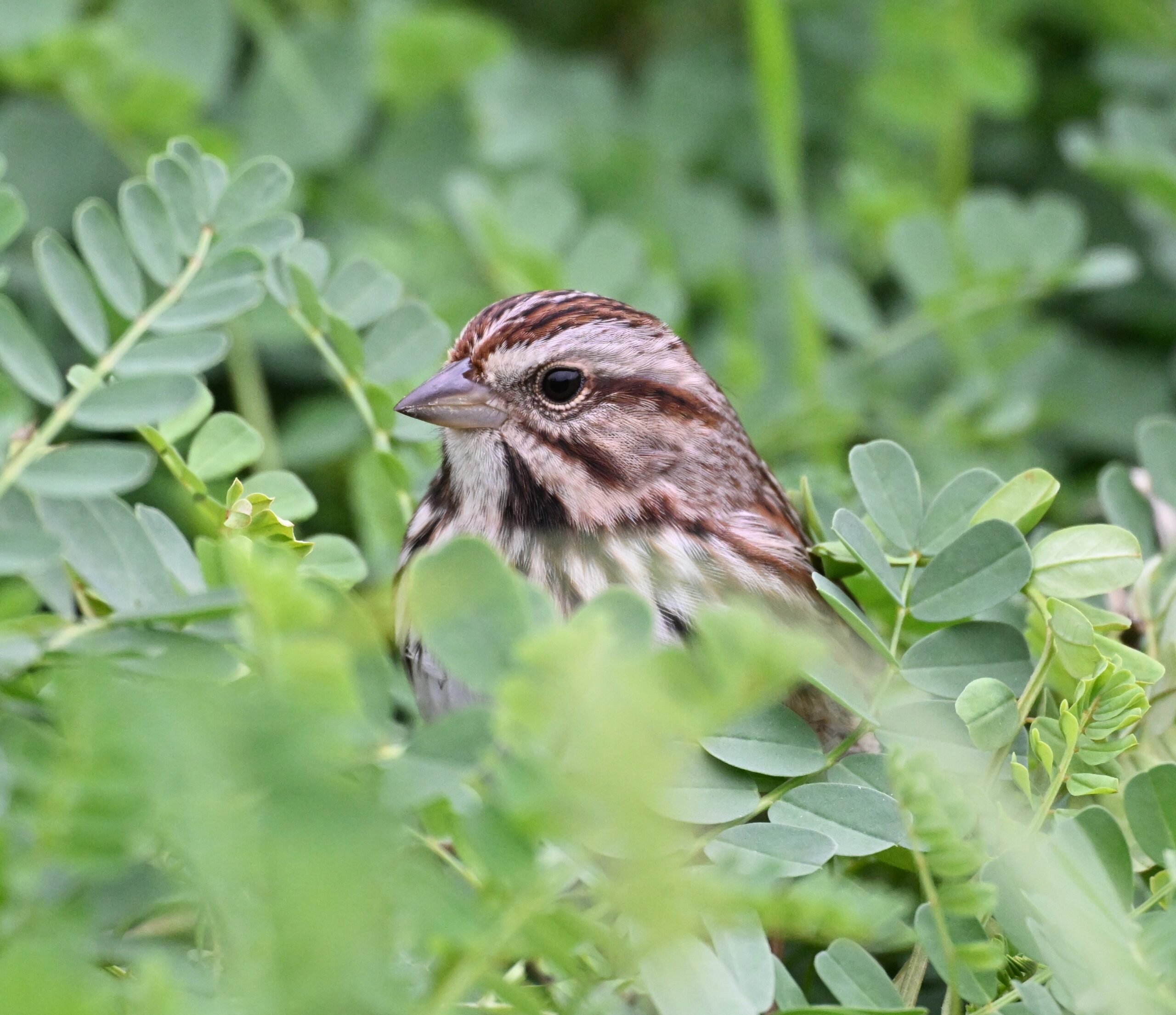
PHOTO COURTESY OF GABRIEL RIVERA, PH.D.
Creighton’s Birding Club collects data on bird strikes across campus to advocate for safer solutions, including fritted glass and window treatments designed to prevent collisions.
Birds are everywhere. In fact, there are well over 11,000 potential bird species according to Cornell Lab. Yet, bird strikes are killing over 1 billion birds a year.
Bird strikes are when a bird collides with a window while flying. Birds can’t see glass as a solid barrier. They actually perceive it as an open space, since the glass can reflect trees and nature. The birds see it as more space to fly through.
According to Gabriel Rivera, Ph.D., a professor in the biology department at Creighton, “these little birds that are flying, you know, 10, 20, sometimes 30 miles-per-hour, and they can’t see clear glass. And so, they fly headfirst into it. It’s essentially the equivalent of you thinking that there’s water in a pool, going on a diving board and diving headfirst into an empty pool.”
The problem is big, open spaces full of glass, like a lot of modern buildings with big glass panels all over.
“Birds have evolved and are adapted to do incredible things, and if that bird sees that there is glass, it can maneuver and usually avoid that with really good success. Because these animals are basically adapted to flying through places with lots of trees and branches, they have to be able to make last second maneuvers. I mean, if you give them a chance, right, they can avoid it,” Rivera said.
One way bird strikes have been reduced is through the implementation of fritted glass. This glass has tiny ceramic discs inside of it, which from afar makes the glass look like it has a slight tint, but up close you can see the discs. The birds can see the discs, allowing them to avoid the glass in time. Fritted glass also has human benefits which was its original purpose, because it can help reduce the amount of heat that regular glass and windows let in.
Rivera said that “just changing to that type of glass, you’re able to cut down [on bird strikes]. They’ve done lots of experiments and studies. You can cut down 90 to 95% of the strikes that occur.”
Creighton has already implemented fritted glass in some of its buildings. The Werner building contains fritted glass. Now, obviously, it is not reasonable to suggest replacing all of the glass on campus with fritted glass, but people have come up with products to actually have that same fritted glass effect without replacing the glass. There are numerous stores and businesses determined to save birds who have invented things like stickers to put on the glass, or even a film to be installed over the glass which still has the same effect as fritted glass.
Birding Club at Creighton is actually collecting data on bird strikes around campus to move forward and push for change.
“There’s the four birds over there. It used to be five. The four birds are over there between Rigge and Eppley. There’s that windowsill that sits right underneath the window. So, then when the bird strikes, it sits there and everybody who passes it can see it and they sit there for years,” Julian Garcia, a graduate student in the School of Medicine and President of Bird Club at Creighton, said. “I’ve also noticed that there have been a lot of them by the Criss building. When there’s no windowsill, you can follow the windows down. There’s this big tower of glass, and then at the bottom there’s a bunch of dead birds.”
Garcia also mentioned the impact bird strikes can have on Creighton from a marketing standpoint.
“If families and prospective students are touring –– freshman labs are a good hot spot for tourists to go visit –– and the families are passing a lot of dead birds, that’s not really good look,” Garcia said.
Students can also help with the data collection Birding Club is doing.
“We’re trying to get as much data as we can on campus. So, if someone has something to send to us, that would be amazing,” Ruby Allen, College of Arts and Sciences sophomore and Birding Club’s treasurer, said.
If you walk around campus and notice a dead bird, or signs of a bird strike, take a photo, then reach out to Birding Club at birdingclub-bounces@lists.creighton.edu, juliangarcia@creighton.edu or on Instagram @creightonbirdingclub. Together, we can all work together to help prevent bird strikes and bird deaths here at Creighton University.