PHOTO COURTESY OF LESLIE SCHULTE & KELLY CHASE
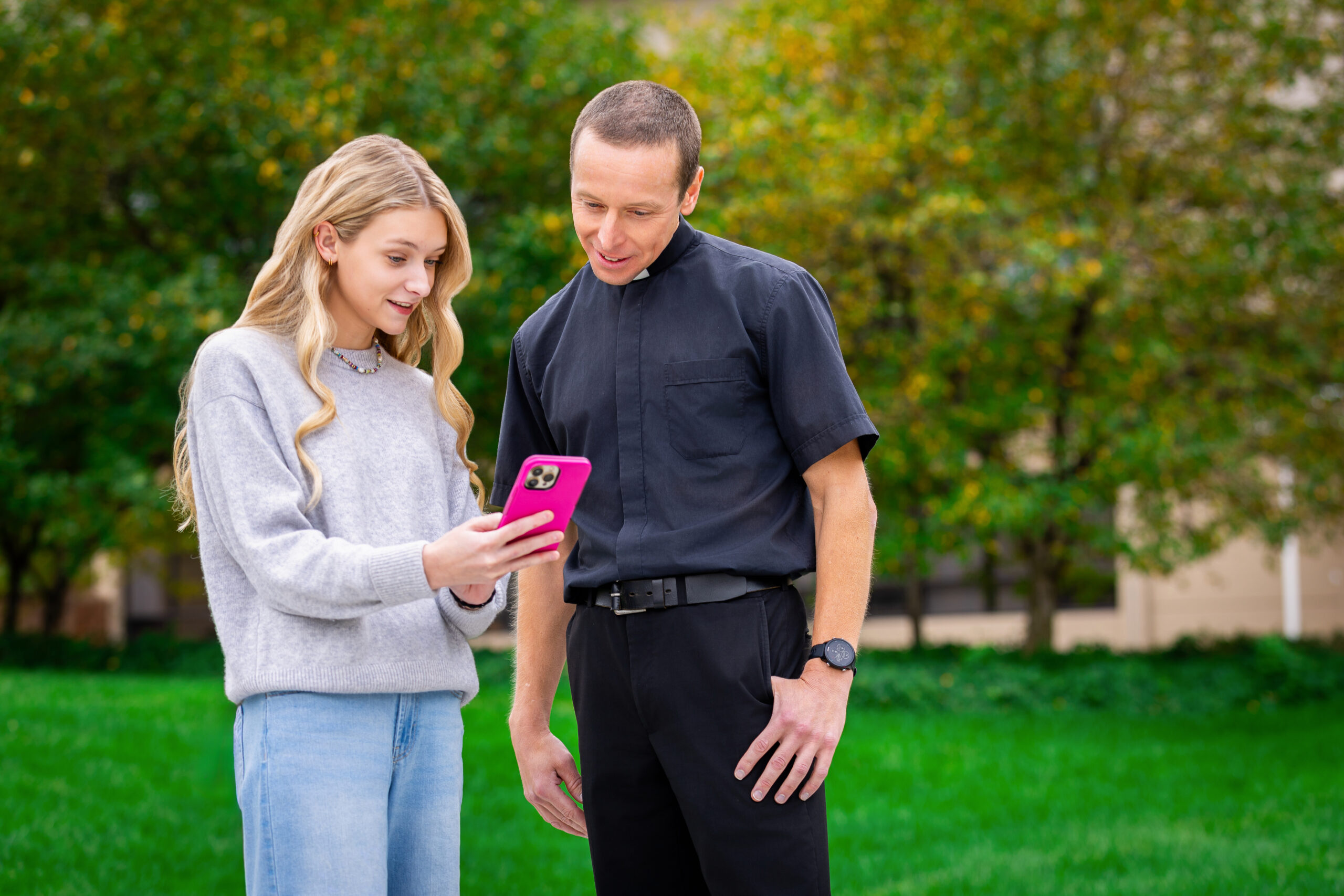
Creighton University faculty and students, both in the undergraduate and third-year medical school programs, team up to create a new app that allows veterans with PTSD to utilize the Jesuit tradition of the Examen as a means of healing and reflection.
In a recently updated version of the veteran data regarding Post Traumatic Stress Disorder (PTSD) made available through the United States Department of Veterans Affairs, it is projected that 7% of U.S. veterans will experience PTSD. A team of Creighton University (CU) faculty and student-researchers are working to create a mobile app, which builds on the Jesuit traditions of the Examen, to help veterans mitigate these symptoms, with the app’s pilot period set to begin in 2027.
“My grandfather fought in Vietnam, and my mom grew up living in many places around the world. I also know plenty of people who are veterans or currently serving … I realize how sacrificial and special their dedication to our country is, and that is a gift. Rev. Krall is also a navy chaplain, and he has been all around the world, too. He has a unique perspective to offer. I also want to go into medicine, and I have seen it from the patient perspective and from the perspective of healthcare workers, and I think that it is delicate, difficult and important work,” College of Arts and Sciences junior Katherine Pansegrau said via email.
Rev. Christopher Krall, S.J., Ph.D., serves as a College of Arts and Sciences assistant professor of theology with a secondary appointment in neuroscience. He is also the principal investigator for the project. According to Pansegrau and Krall, the foundations to the app’s research were derived from part of Krall’s dissertation, which began in 2022, that examined the theological and neurological concepts of suffering.
“Research [for the app] began around Fall 2025, when I reached out to Rev. Krall inquiring if I could get involved with his research. I went in with an open mind, and I am very grateful I did that,” Pansegrau said via email.
In the summer of 2026, Pansegrau was awarded a Summer Undergraduate Research Fellowship (SURF) and was funded by the Kripke Center for the Study of Religion and Society. Current funding for the project was also awarded through the Dr. George F. Haddix President’s Faculty Research Fund at the university. As for the team, Pansegrau works alongside various other Creighton faculty members and students, both undergraduate and graduate, across various fields of study.
“Our research group is composed of myself, Rev. Krall, Dr. Steven Fernandes, Dr. Amy Badura-Brack, four other Creighton undergrads (Leah Ambrosy, Lauren Kmetz, Madeline Mullen and Campbell Woodbury), three M3s [CU School of Medicine third-year medical students] (Bianca Widjaja, Tyler Cunningham and Ali Mauritsen) and Dr. Ramaswamy at the VA (and his residents!),” Pansegrau said via email.
The app is geared towards providing a reflection-based coping mechanism based on an ancient Jesuit prayer tradition, the Examen. Krall also serves as a Reserve Naval Chaplain, and it is through his nine-month deployment in 2025 that he recognized the deep correlation and potential the Examen has toward aiding veterans with PTSD.
“There’s this whole history of Jesuit spirituality founded by a soldier, St. Ignatius of Loyola, who had a pretty traumatic experience of a cannonball injury, and he started putting these different prayer practices together that have been passed on from generation to generation for the last 500 years. There’s something important about these … now, that we have all this technology and ability to do research on this, we [can] study the effects of [the prayer practices], especially when we’re finding with people coming back from these … military engagements with more and more symptomatic issues with post-traumatic stress, as well as moral injury,” Krall said. “And it’s a kind of a question [of], ‘How do we deal with this’ and they’re trying to find different drugs. Psychedelics is a big area. But what I’m trying to develop is going to be a substance-free version of treatment. The [Examen] … goes [back] 500 years ago to a soldier who had trauma. And maybe we should explore, instead of reinventing the wheel or trying to figure out something new, to bring out the wisdom of the ages, especially of the Jesuit Catholic value and the Christian value; kind of wrestling [with] and recognizing suffering, but that we’re not alone in the suffering.”
Steven Fernandes, Ph.D., a College of Arts and Sciences assistant professor of computer science, was approached by Krall to assist in the building of the application as his research specialized in Artificial Intelligence (AI) and its inclusion in healthcare.
“The app will assist veterans with PTSD through Ignatian spirituality, i.e., the five steps of the Examen. It guides users through one session a day for 42 days, and AI helps select the questions,” Fernandes said via email.
The five steps of the Examen, according to Krall, correlate to a physical component of reflection that incorporates the usage of the individual’s hand.
“We use each finger as a kind of a pneumonic device for these five steps of doing an Examen … we are encouraging our participants of our study to do [the Examen] once per day … it should take about 10 to 15 minutes when doing it. But it’s the idea of a self-reflective, intentional, kind of engag[ing] kind of mental exercise or spiritual practice of focusing one’s thoughts,” Krall said.
Each finger represents a specific prompt that an individual will answer during this daily reflection exercise. The thumb prompts reflections of thankfulness, the pointer finger prompts the individual to point out areas for desired growth, the ring finger prompts for areas in which the individual wishes to seek covenant or dedication to goodness and the pinky finger prompts prayer for strength and grace as the individual work towards healing. As for the middle finger, which prompts reflections of where the individual finds the greatest sense of meaning in life, Krall also recognizes that there is another mainstream meaning of the middle finger.
“Now the idea is instill[ed] in the context of gratitude and with this desire to grow from the pointing out, but the sad reality is many of us can go through life and ‘flick the bird’ to people or ‘flick the bird to life.’ So, that middle finger can have multiple different ways. So, we become more pessimistic of our life or of all these bad things [that] started happening, [in] some ways [we] almost see life is meaningless … [and] can just [get] caught in this grind [of] all these bad things have happened and I don’t find meaning,” Krall said.
With the structure of these exercises rooted in the Catholic Jesuit tradition, there is some worry regarding possible discouragement of users of the app who are of different faiths. However, according to Krall, the act of reflecting through thankfulness is a practice that transcends religious boundaries.
“The basic principles are about gratitude. That’s pretty human … it’s human [to] point out our past flaws, finding meaning in life, recommitting to something that you find valuable in your life and then having that kind of having this desire to move forward for a next-best step and having some guidance of how to do that in,” Krall said. “You don’t have to have a deep and intimate and profound relationship with God or Jesus himself, but it’s the fact … that there are these traditions that we can pull from and glean wisdom from, and that there could be this element of something [or someone] beyond yourself that cares about you and wants you to be at your best and can offer the gift of grace to guide in that process.”
Fernandes also believes that this app has the potential to reach wider audiences as well.
“Much of the wording is broad. It speaks of ‘the source of life’ and ‘your source of peace,’ so people of any faith can use it. Gratitude, meaning and hope for tomorrow are for everyone,” Fernandes said.
As the app still awaits further approval to begin its formal pilot program, the team hopes that the application, along with its AI features to further cater the app-experience for each user, will allow for a more accessible alternative for all individuals who are in need of self-reflection to get the help they need from the palm of their hand.
“Resiliency, gratitude and self-improvement are all skills that we have to practice over time. It is not instantaneous, and it can be difficult at times, but having this growth is important to live a happy, healthy life. This growth also is correlated with more positive mental health outcomes for everyone. Other treatments can [be] and are useful, but the Examen is a non-pharmaceutical option that is backed by surviving centuries, as well as neuroscience research that shows the benefits of prayer and meditative practices,” Pansegrau said via email.
Creighton University faculty and students, both in the undergraduate and third-year medical school programs, team up to create a new app that allows veterans with PTSD to utilize the Jesuit tradition of the Examen as a means of healing and reflection.