PHOTOS COURTESY OF JIM WILLIAMS
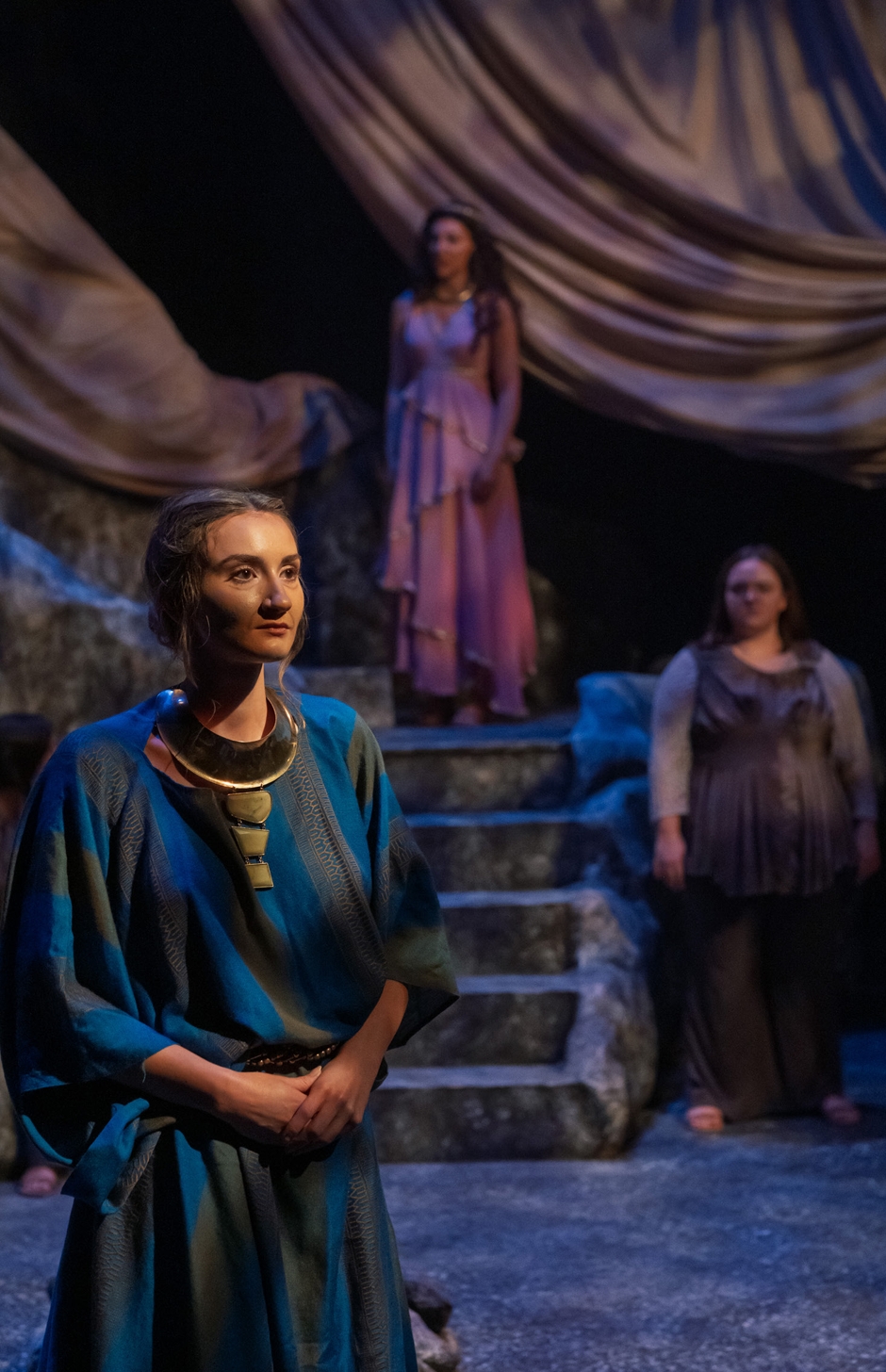
Creighton Theatre’s production of The Trojan Women explored the aftermath of the Trojan War, highlighting Hecuba and the women of Troy as they faced the loss of their families and futures.
From September 23-27, the Creighton Theatre Department put on their fall production “The Trojan Women,” a Greek tragedy telling the story of a group of women after the Trojan War.
And a Greek Tragedy this show was. The show explored themes of grief, loss, assault and violence. While exploring heavy topics, the depiction was done with grace, elegance and what one could see was a true respect for the women being portrayed.
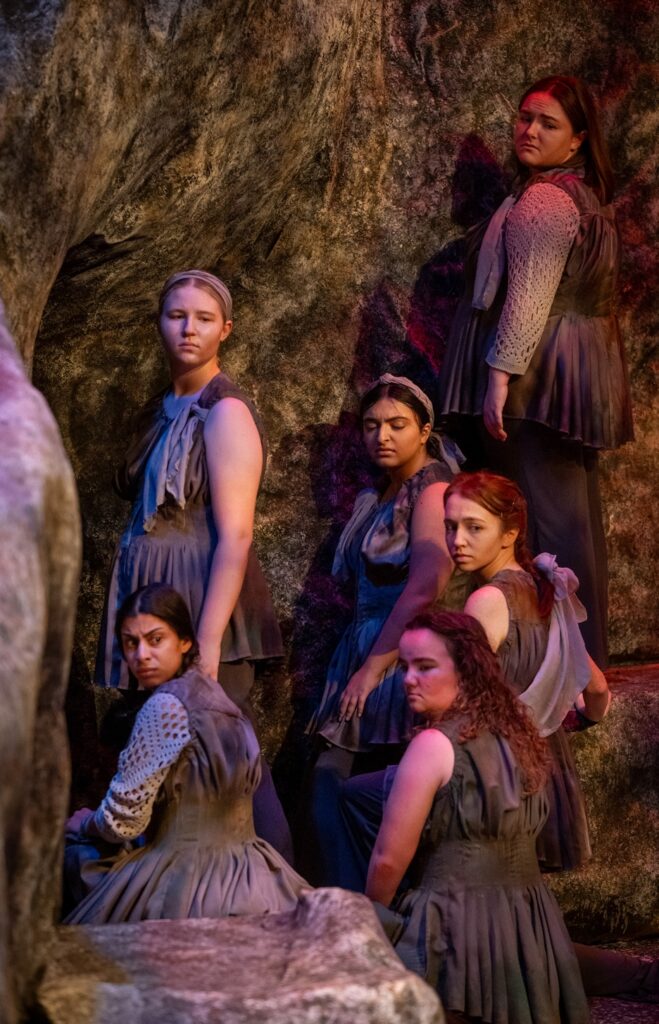
This Creighton theatre experience was unlike any other. Instead of the traditional theatre that students may be used to going to for past shows, students are led to a black-box type of theatre setup, walking basically straight onto the set of the show. The ground and rocks in the set are littered with the chorus women and Hecuba –– Queen of Troy (Erin White) –– scattered and laying down until the show begins.
While the lighting of the show is extremely dim as the audience enters, the set lights up and starts the performance with Poseidon (Owen Sayers), speaking to the audience about the story that would occur, and how the great city of Troy was about to be ruined forever.
The story begins with the women (played by Eva Quam, Leah McEvoy, Leila Sobhani, Laura Molina Arroyo, Amanda Seeliger and Alora Menzies) confused, worried and convinced the war was all just a bad dream, all to find out that the tragedies of the Trojan war were a reality.
The women of Troy look to their dethroned queen, Hecuba, who can only offer the truth to the other women; that they were to be sold and married to Trojans in Greece, and to take in their last moments of their beloved home in Troy, now gone.
Conflicts in the story arise also, in the form of Helen of Troy (Julia Romero) and Cassandra (Emma Borkstrom), daughter of Hecuba. Cassandra, seemingly gone mad, is to be married to the king of Greece, and Hecuba questions why Cassandra has been cursed. Helen of Troy speaks to her own experiences, while hated by the women of Troy for her hand in their suffering and delivery to Greece.
All while the story unfolds, the true travesties and grief are portrayed by the chorus women and Hecuba. Their story is a tale of suffering. Their grief and pain are taken out on Helen of Troy, when Hecuba orders that the women of Troy take her and take revenge on her, only for Helen to speak that nothing they can do or say is worse than what those who control her will do to them, and her.
This tale continues with Hecuba’s daughter-in-law Andromache (Annie Herfordt), who attempts to remain joyful despite her situation, and is seemingly blessed by a son in the light of her husband’s death. In the beginning of her story, she talks about telling her husband’s bravery to her son, and Hecuba speaks of being blessed with a grandchild. Since many of the other children in Troy have been casualties of the war, this is a true symbol and source of joy in the story.
However, this joy is short lived, as Talthybius (Jonathan Shelton), a soldier of Greece, comes to notify Andromache that her son must die, under Greek orders. Andromache gives an emotional goodbye to her child, who was such a symbol of hope and life for herself and Hecuba.
The story ends with the women going to their new lives, or lack thereof. Hecuba and the women give a passionate and grieving farewell to Troy, and just like that, the story fades into dark and is over.
Erin White, who played Hecuba, said that “it was really, really special to be able to play a role that’s been a testament to the human experience and specifically the experience of women throughout thousands of years.”
“The play takes place just hours after the city has been destroyed, so she’s trying to grapple with those feelings and these experiences.”
“Often we hear of the glories of conquest, but we don’t think about the survivors of it … telling these stories is important,” White added.
In an online interview with Julia Romero, who played Helen of Troy, she mentioned that “[Helen] is such a known character, but also so misunderstood … at her core, she truly is just a pawn of the Gods, but she’s blamed for everything that happens in really terrible ways.”
“Portraying Helen really felt like expressing the rage and pain of every woman, and it was really powerful to do that,” Romero added.
Bella Loftus, the lighting designer of the show, mentioned that “it’s empowering to be able to platform those [refugee] stories at Creighton University, that center around women struggling to survive.”
“I really wanted to honor the work being done on stage with the lighting I did, so I really tried to isolate Hecuba or give the chorus their moments when they were speaking,” Loftus said.
“They’re all speaking through the trauma and the horror they’re experiencing in real time … the lighting helps you stay present and follow that emotional arc.”
The dedication and emotion behind the cast and crew’s portrayal of “The Trojan Women” was intentional and done with clear care and true want to share this deeply emotional story.
If you missed “The Trojan Women,” stay tuned for the Creighton Fine Arts Department’s other productions later this year, or attend the Spring production of “Little Women.”