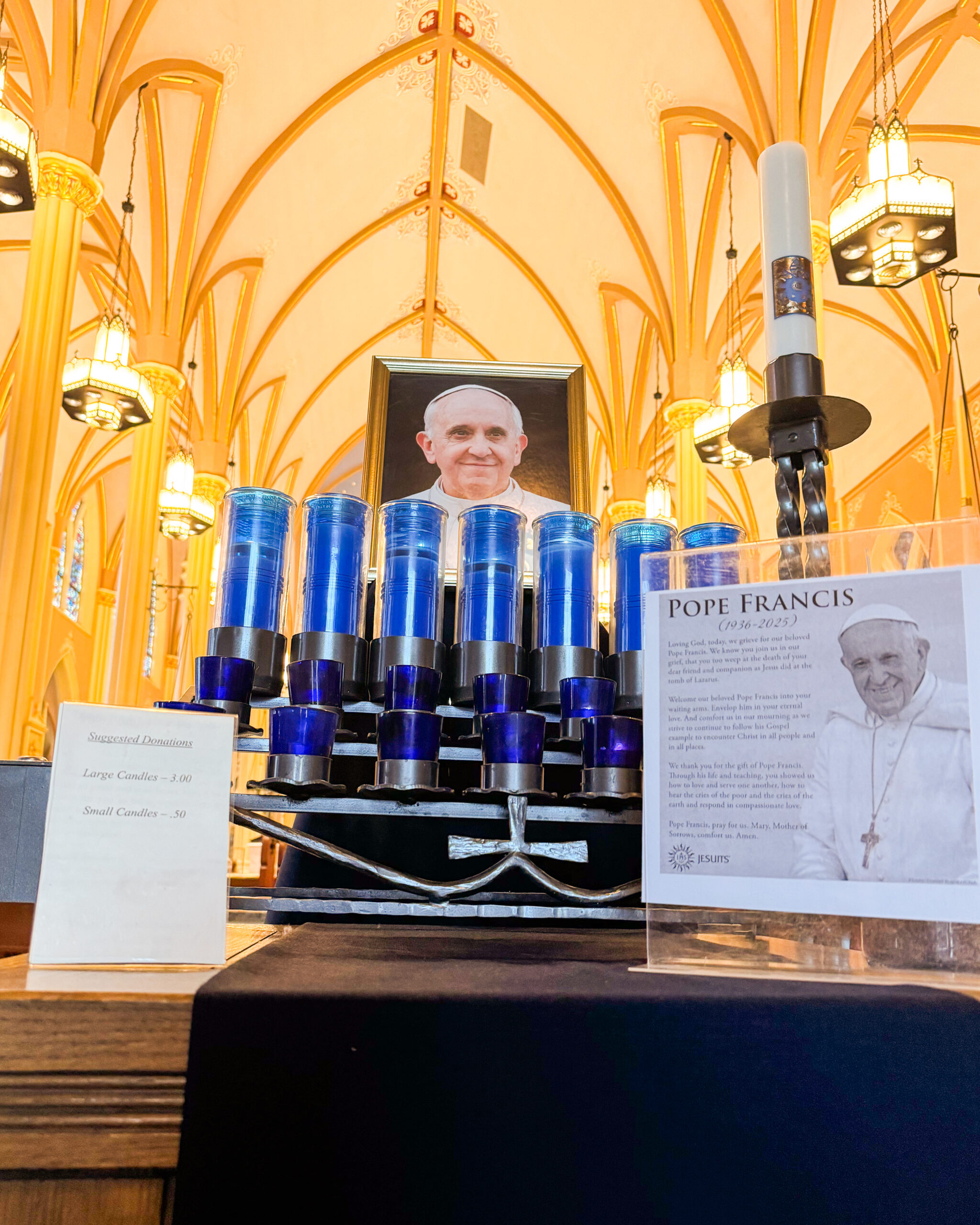
Pope Francis, born Jorge Mario Bergoglio in Argentina and the Catholic Church’s first Jesuit supreme pontiff, died on the morning of Easter Monday at age 88.
According to the Vatican, his cause of death was a stroke, which was followed by a coma and cardiocirculatory collapse. Some of his prior medical history included acute respiratory failure caused by multimicrobial bilateral pneumonia, multiple bronchiectasis, high blood pressure and Type II diabetes.
“As the first Jesuit pontiff in the history of the Catholic Church, there is no way to quantify the ways in which Pope Francis’ leadership helped reaffirm our own Creighton mission,” Creighton University President the Rev. Daniel Hendrickson, S.J., said in an email to the entire Creighton community. “His compassion for others and commitment to a ministry that exists not just in the physical confines of a Church but in the actions we take will leave an indelible mark on the future of the papacy.”
Sam Garcia, a junior in the College of Nursing who is heavily involved with Campus Ministry, shared Hendrickson’s sentiments and reflected on the late pope’s impact, especially as a leader.
“I just think as college students — whether we believe in Catholicism, or whatever other religion, if you believe in a god, if you don’t believe in a god — that you can view Pope Francis as a leader. … Overall, he was a pope that led to serve, to be in community with others and to love those who are overlooked,” she said. Garcia is currently a Christian Life Community co-coordinator, a co-coordinator for the Fall 2025 Encounter with Christ Retreat and participates in the Candlelight choir.
Being the first Jesuit pope made Pope Francis especially significant to Creighton.
“The excitement on campus [after he was elected pope] was really palpable. Everyone was very excited that we had a Jesuit pope. And I think I can confidently say that a lot of his papacy included elements of Ignatian spirituality; that’s part of our mission at Creighton,” Molly Mattingly, Creighton’s director for music ministry, said.
The sadness of his passing can be felt on campus.
“[As a Jesuit Catholic university,] it certainly means that we lose a figurehead for us over the last 12 years regarding how we articulate our mission and how we live out our Catholic faith,” the Rev. Eric Immel, S.J., who works at Creighton as a vocation promoter for the Midwest Province of the Society of Jesus, said. “A faith that is merciful, a faith that is committed to the poor, to the work of justice, a faith that has particular responsibilities to ecological justice, a faith that goes to the margins and encounters people where they are, a faith that promotes a deep Catholic Ignatian spirituality. He was the first Jesuit pope. Certainly he was on our side when it comes to expressions of Catholicism. And so, we lose a lot. We lose a lot with his passing.”
Pope Francis was elected as the Church’s supreme pontiff on March 13, 2013, following the resignation of Pope Benedict XVI. As a pope of firsts, Pope Francis was the first Latin American pope, the first non-European pope in more than 1,200 years and the first to take St. Francis of Assisi as his papal name — reflecting his commitment to caring for the poor and the environment — in addition to being the first Jesuit pope.
“As the first Jesuit pontiff in the history of the Catholic Church, there is no way to quantify the ways in which Pope Francis’ leadership helped reaffirm our own Creighton mission. His compassion for others and commitment to a ministry that exists not just in the physical confines of a Church, but in the actions we take, will leave an indelible mark on the future of the papacy.”
The Rev. Daniel Hendrickson, S.J., Creighton University President
His legacy will be one of inclusion, as he advocated for acceptance of LGBTQIA+ people, care for migrants and a greater stewarding of the environment, among other social justice issues.
“I think his legacy, overall, is focusing on all of our differences and the beauty of them,” Garcia said. “He stood for loving all those who identify with the LGBGTQ+ community, and he stood for loving prisoners and washing their feet. Just focusing on all of our beautiful, different gifts — I think that’s one of the biggest legacies that he left.”
Mattingly echoed this and expanded on his legacy of inclusion.
“I hope some of his legacy is going to be what he started with the Synod, which is to create a culture of a listening Church that values all the voices. … Over the course of his papacy, he put women — lay women and religious women — in leadership roles where he could, in high positions in the Church, which I hope will have a continuing effect,” she said. “He made cardinals from many different areas of the world…[in] Catholic communities that didn’t have cardinals representing them up to this point because they were so small, is my understanding. So, apart from those structural changes, I hope that the tone that he brought to the Church continues. He just had such a gentle way of speaking to people and standing in compassion while representing the Church and encouraging us to find joy and hope. … [He encouraged us to] be pilgrims, have a relationship with Jesus and meet people where they are.”
Mattingly added that she hopes to see “Pope Francis’ focus on care for creation, care for the marginalized and the poor, [care] for those who have felt ostracized from the Church (especially LGBTQ+ Christians), and care for those who have experienced harm in the Church [continue].”
“In short, he lived a lot of good,” she said.
A standout example of the love, humility and inclusion that the late pope displayed is his decision to expand the traditional Holy Thursday foot-washing ritual. From the beginning of his papacy, Pope Francis was the first to include women and people of other faiths in the ceremony, which traditionally involved the pope washing and kissing the feet of 12 Catholic men, symbolizing Jesus’ service to his disciples. Each year he visited a prison, refugee center or youth detention facility to perform the ritual, emphasizing his dedication to serving the marginalized. Although his health prevented him from performing the ritual this year, he still visited with 70 inmates in Rome’s Regina Caeli prison and, according to the Associated Press, Pope Francis told the inmates that he was unable to wash their feet but still wanted to be with them and “do what Jesus did on Holy Thursday.” Last year, he washed the feet of 12 women incarcerated in a Rome prison.
“[He made] it known that the Jesuits do things [in] maybe different ways than [others] do. They want to get down and dirty with the people in society who need our help the most, and that’s really what I saw from [Pope Francis] and from the Jesuit community. … He did it differently, and that’s… how I feel like Jesuits also do it,” Heider College of Business sophomore Jacob Holzfaster said. He is involved in Campus Ministry in various positions, including co-coordinating Christian Life Communities for the upcoming academic year and working as the mission and ministry executive for Welcome Week.
The late pope’s successor will be chosen by a conclave of cardinals who will meet within 15 to 20 days after Pope Francis’ death. The cardinals will continue to vote on who the next pope should be until someone has been selected with two-thirds of the vote.
“We hold the tension of the sadness of this moment, but also the joy of God’s work and helping to continue making this Church anew,” Immel said. “My prominent feeling is one of sadness and one of gratitude for what Pope Francis has been able to do for us. In this tension there’s a certain joy in trusting that the Church continues, that the work of Christ on Earth continues and that we have this opportunity for something new as well.”
Creighton will celebrate Pope Francis’ life and ministry at two papal Masses. The first Mass took place on the university’s Phoenix today, Wednesday, April 23. The Mass on the Omaha campus, which Hendrickson will preside over, will be in St. John’s on Saturday at 5 p.m. St. John’s will provide a livestream of the Mass for those unable to attend in person. After the Mass in Omaha, the church bells of St. John’s will chime 88 times, reflecting Pope Francis’ age, in his remembrance.
“Let us pray for Pope Francis, the Catholic Church and for all those who are missing his presence today. As we reflect on his legacy, let his words be a light to shine a path forward toward a better world for all,” Hendrickson’s email said.