PHOTO COURTESY OF PARKING SERVICES
New parking system changes how Creighton students use campus lots
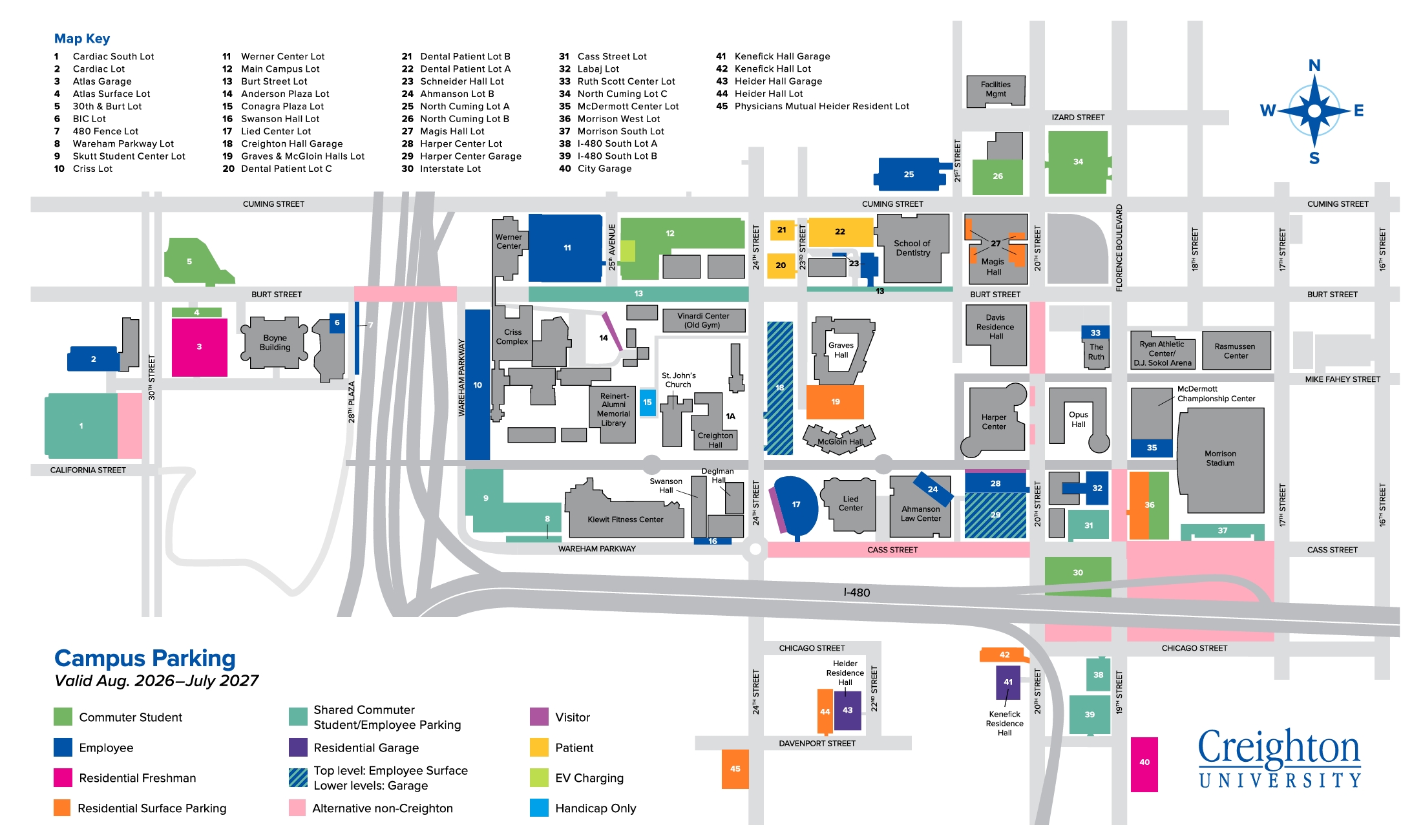
Creighton University has implemented a new parking system for the 2026-27 academic year, changing how students park on campus and separating parking areas for residential and commuter students.
The changes include new parking lot signage, designated areas for first-year students, updated parking permits and new time restrictions for commuter parking. University officials said the changes are intended to improve parking availability, campus safety and navigation.
Jessica Weaver, the university’s parking technical specialist, said new signage is one of the most noticeable changes to the system.
Rather than relying on the previous lot-numbering system, the new signs identify lots using nearby buildings and landmarks to help drivers determine where they need to park. The signs are also about twice the size of the previous signs and are intended to be easier for drivers to see and understand.
The new system also separates campus parking into residential and commuter areas. Commuter permits are valid only in designated commuter parking areas or approved commuter garages from 6 a.m. to midnight. Overnight parking is not permitted with commuter permits, according to Creighton’s parking information.
“Most academic buildings close at midnight, so they should be leaving anyways,” Weaver said.
Weaver said the separation is intended to improve daytime parking availability while allowing Public Safety to focus on residential areas where vehicles may remain overnight.
“It’s that safety initiative trying to empty out those lots and also turn them over in the morning so that it’s a fresh clean lot when people come in,” Weaver said. “So far it really has allowed us to open up certain lots each day because they kind of clear out at night.”
The university also used data to help determine which areas should be designated for residential parking. Weaver said Creighton identified areas that were more vulnerable based on statistics in the university’s annual report and issues reported by the Creightonian.
“Those were the areas we wanted to avoid putting vehicles that would sit for long periods of time without being checked,” Weaver said.
For first-year residential students, the changes mean vehicles are restricted to designated parking locations. First-year students living on campus may park only in the 30th Street Garage or the City Garage at 19th Street. They are not eligible to park in main-campus residential garages or surface lots.
“That’s more than 400 vehicles that are no longer competing with regular upperclassmen and commuting students,” Weaver said.
First-year students were placed in the garages in part because they generally use their vehicles less frequently than other students, Weaver said. The garages also provide protection from the weather, while Atlas and the city garage have patrols or coordination with Public Safety to monitor the areas.
For some first-year students, however, the distance between residential parking and the center of campus has added time to their daily routines.
Brendan Reilly-Suarez, a first-year student in the College of Arts and Sciences who keeps a car on campus, said having a vehicle allows him to travel off campus and get to his job.
“It’s really annoying having to park so far away because I have to wake up like 20 minutes earlier than I would because I have to do a 15-minute walk to my car before I can even start driving,” Reilly-Suarez said.
Reilly-Suarez said he understands why the university has separated residential and commuter parking, even though he finds the distance inconvenient.
Although the garages are farther from the center of campus, Weaver said the arrangement is intended to reduce congestion and encourage first-year students to use other forms of transportation, including the JayPass program. JayPass allows Creighton students to ride the Metro bus system at no cost with their Creighton ID.
The university also added approximately 35 parking spaces through a lease at Physicians Mutual. Weaver said the lot provides students with a secured parking area and a guaranteed space.
The new parking system also eliminates Health Sciences and perimeter permits. According to Creighton’s parking information, commuters are now treated the same regardless of which school they attend.
Steven Nguyen, president of the College of Arts and Sciences Student Senate, said the new commuter classification does not account for differences among health sciences, undergraduate and professional students, whose schedules and campus needs can vary.
Students can choose between annual permits and semester-only permits. Monthly and weekly printable permits are no longer offered. Heider residents also have an additional residential surface parking option at the secured Physicians Mutual lot. The hours for weekend-only permits have also changed. Weaver said weekend-only permits are valid from 4 p.m. to midnight on weekdays and from 6 a.m. to midnight on weekends. Previously, the permits were valid for longer periods.
“They used to be good the whole time,” Weaver said. “That is no longer the case.”
Naomi Kurtz, a sophomore in the College of Arts and Sciences who commutes to Creighton, said the drive to campus is short, but finding a parking space can significantly increase her commute.
“I only live 10 minutes away, but I have to spend a large amount of time searching for an open spot,” Kurtz said, “and even then, I am still not guaranteed a spot.”
Kurtz said she leaves at least 45 minutes early if she wants to find a parking space relatively close to campus. Kurtz said the cost of her commuter parking permit has also contributed to her frustration.
“I spent $450 on a parking pass that is basically useless,” Kurtz said.
Nguyen also said the changes have reduced parking availability for faculty and staff, shifting the burden of limited parking rather than addressing the underlying shortage.
“Senior leadership is the one that makes all of the policy decisions.” Weaver said. “So, Deans levels are brought in, VP levels, then ultimately they’re the ones that make the decision. We give input.”
The university has also identified parking areas that are sitting empty, although some are farther from the center of campus. Weaver encouraged students and employees to plan ahead and allow additional time to find parking.
“If you have a 10:00 [a.m.] class, maybe come and study before class,” Weaver said, suggesting students arrive early to avoid peak parking congestion.
“There’s space. You just might have to go a little further,” Weaver said.
Nguyen said the new system also places more responsibility on the Juttle, which he described as historically unreliable and understaffed, in hopes that less cars will come to campus.
Creighton is also exploring technology that could help students, employees and visitors locate available parking spaces. Weaver said she is working with Information Technology on a potential parking guidance system that could eventually allow users to find open parking spaces through an app.
The project is still in its early stages, and the university has not determined which technology or program it will use.
Nguyen said the university should use objective data and direct student feedback to evaluate whether the new parking system is improving parking on campus. The College of Arts and Sciences Student Senate works with the Creighton Student Union and university administration to advocate for changes.