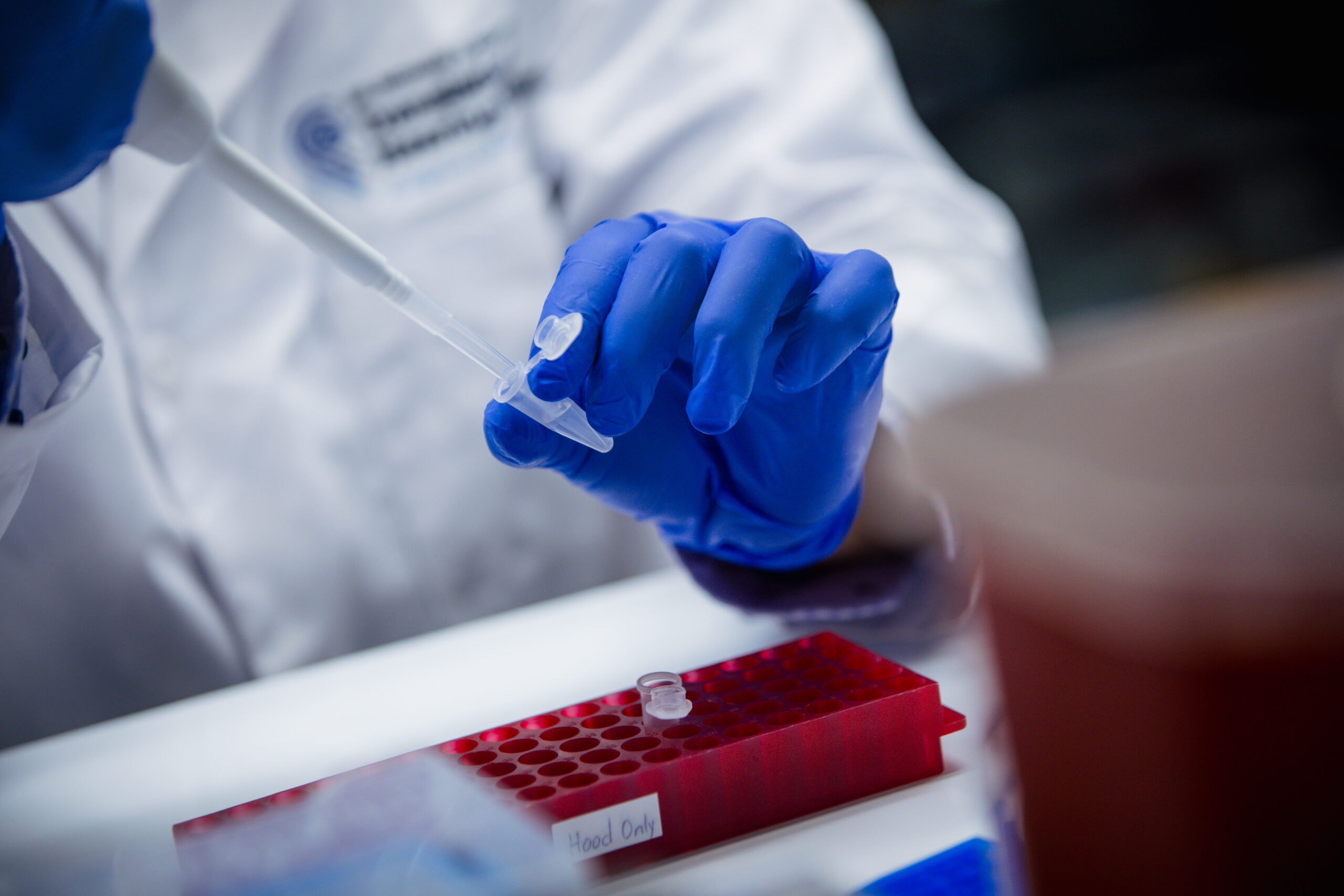
PHOTO COURTESY OF UNIVERSITY COMMUNICATIONS AND MARKETING
Creighton University’s Dr. Richard J. Bellucci Translational Hearing Center continues to advance their research on the causes of hearing loss and methods of prevention and rehabilitation on the biological level, helping improve treatments for patients with hearing loss.
On Wednesday, Aug. 19, Creighton University’s Dr. Richard J. Bellucci Translational Hearing Center announced that it has been awarded a $10.9 million grant renewal by the National Institute of Health (NIH) via Creighton News.
“The new grant funds a good chunk of the hearing center … but it primarily funds our early career faculty that are just starting to build their labs … So, the bulk of the grant goes to some of them grow their research programs, get data, get papers out and be competitive for their individual grants which then brings more money and research opportunities to Creighton,” said Associate Director of the Bellucci Translational Hearing Center, Allison Coffin, Ph.D.
Coffin also serves as an associate professor in biomedical sciences at the university. According to her, this grant, which is a part of the NIH’s Centers of Biomedical Research Excellence (COBRE) program, is structured in three phases. In 2021, the university was awarded with Phase One that funded the initial five years. Aimed at providing funding to federally under-funded research institutions, Creighton was able to jumpstart the expansion of their program through new faculty, technologies and individual research programs pursued by the early career faculty.
“[The center] grew a lot … This grew from ‘Oh yeah, there’s some cool hearing research going on at Creighton,’ to ‘This is one of the best places in the country to do it’ all in five years,” said Coffin.
Jemma Webber, Ph.D., member of the Bellucci Translational Hearing Center, and an assistant professor in biomedical sciences, says the purchasing of new technology during that time had allowed her to further advance her endeavors in investigating the signals that control the development of the inner ear.
“I have personally benefited from the new AXR microscope that was obtained during the first award. This specialized microscope allows us to examine structures at very high resolution, which is particularly important for our work because some of the structures we study in the inner ear are incredibly small,” said Webber via email. “Before we had access to this microscope, we struggled to visualize these structures in enough detail. This new capability has already allowed us to identify a previously unrecognized phenotype in our model that we are really excited to investigate further.”
With this renewal, known as Phase Two, which is aimed at providing continued financial support to the research program through similar methods, Coffins and Litao Tao, Ph.D., an affiliate of the center and an assistant professor in the Department of Biomedical Studies, emphasized the importance of its funding toward faculty salaries. Tao, when he initially joined the center in September 2021, gave credit to the NIH COBRE grant for allowing him the ability to conduct his hearing research at Creighton.
“I would say without that COBRE, I [wouldn’t have] been able to join Creighton, because this COBRE grant allows the center to make new recruitments. So, we can recruit new investigators like me five years ago, and now we are going to recruit more new young investigators. So, I would say without it, [I’d] probably [be] somewhere else.”
Especially when it comes to collaboration, Tao also stated that the consistent recruitment of new faculty has helped researchers gain access to expertise across various fields.
“With the center grants [and] with the COBRE grants, we are able to have a collection of expertise and make our life much easier. So, instead of shooting [an] email to someone [or] scheduling a meeting, I can just knock on someone’s office door and say, “Hey, I’ve [got] a question for you. Can you help me with that?”
As for Coffin, she also has found herself benefiting from the expansion of faculty as, she stated, that the flow of ideas within the center has extended far beyond the lab setting as well.
“I was heating up my lunch earlier today talking to Dr. Tao’s colleague … [and] we had a five-minute conversation where he was helping me think through how to do it better because he’s an expert in this technique. You don’t find that a lot of places and so that’s really what drew me here and, I think, what drew so many of us, is the ability to work with each other and bounce ideas off each other and collaborate in a way that’s just not possible in the hearing world and in most other places.”
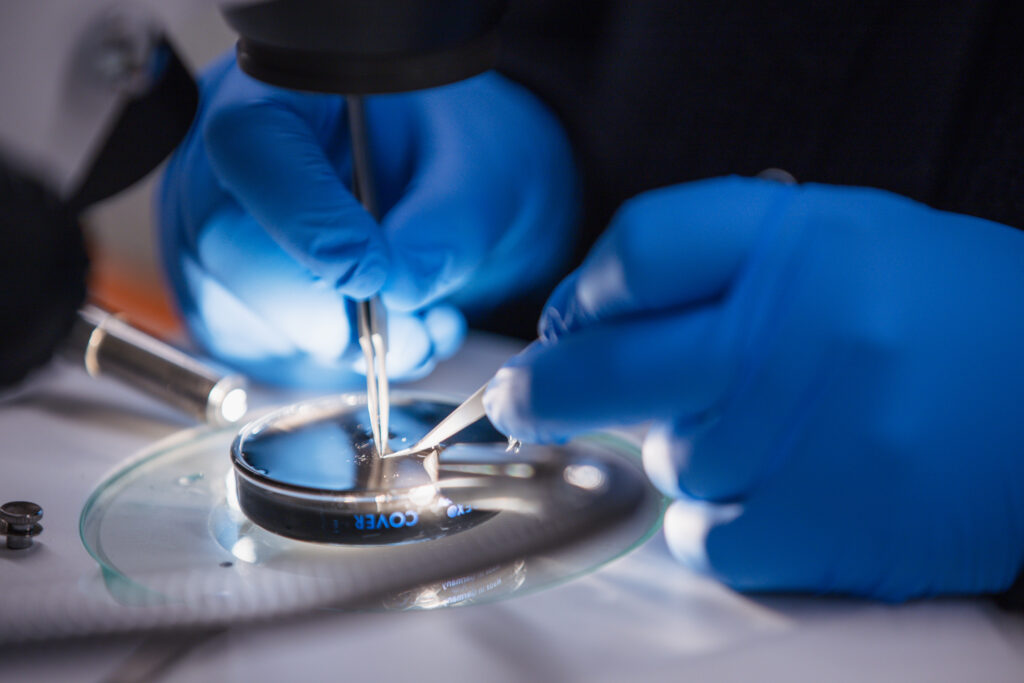
PHOTO COURTESY OF UCOMM
Creighton University’s hearing center receives $10.9 million NIH Phase Two renewal grant.
In addition to funding new faculty members, the grant also contributes to the salaries of graduate and undergraduate students who assist alongside researchers. Though required for graduate studies, according to Coffin, Tao and Webber, their students’ presence has been proven to be invaluable both in the laboratory and the center as a whole.
“My graduate students are absolute rock stars. They have really thrown themselves into this work and are the driving force behind our projects. They are enthusiastic, eager to learn, and always willing to help one another. They have also taken on responsibility for mentoring our undergraduate students, and it has been incredibly rewarding to watch them develop not only as scientists, but also as mentors and leaders,” Webber said via email. “Our undergraduate students are already developing into great scientists themselves. They come into the lab with positive attitudes, are eager to learn and are willing to tackle even the most tedious experiments that are part of doing research. I have seen so much growth in them … I am incredibly proud of the team we are building. Their enthusiasm and willingness to support one another make the lab a really enjoyable place to work, and ultimately, they are the people who make this research possible.”