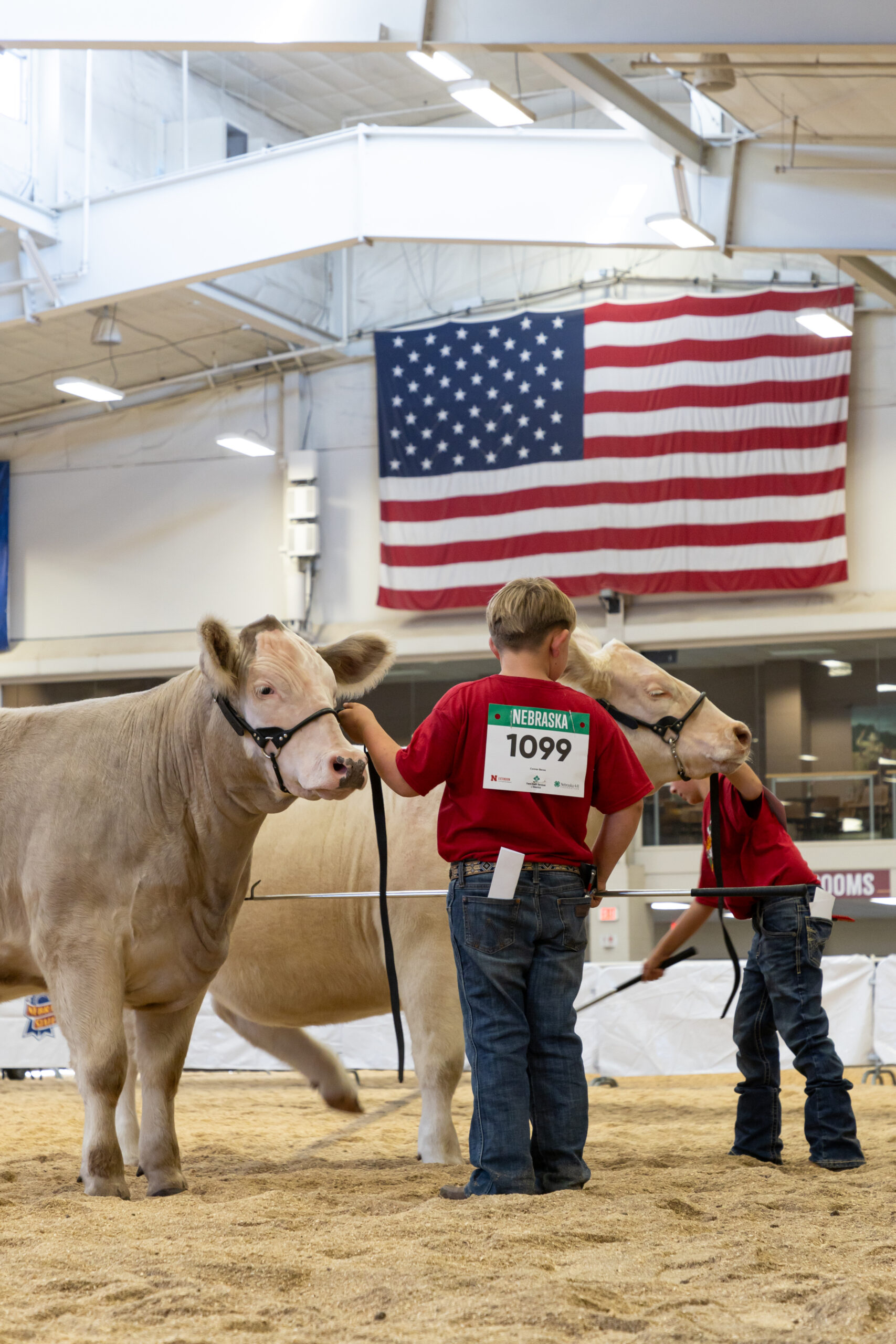
The smell of roasted corn drifts past the neon signs for Outlaw Fries, Slush Factory and Pizza Hut. Live music carries across the fairgrounds. A street-side magician works a small crowd, and the Sky Tram keeps moving overhead. Everywhere there are bright colors, people, music and food.
Then the smell changes.
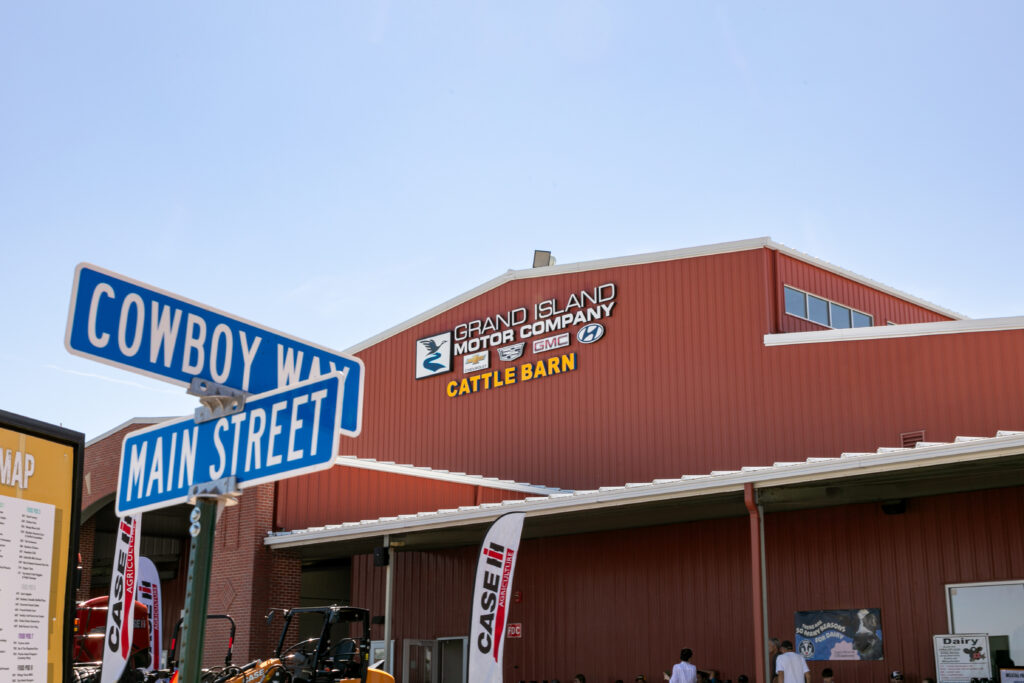
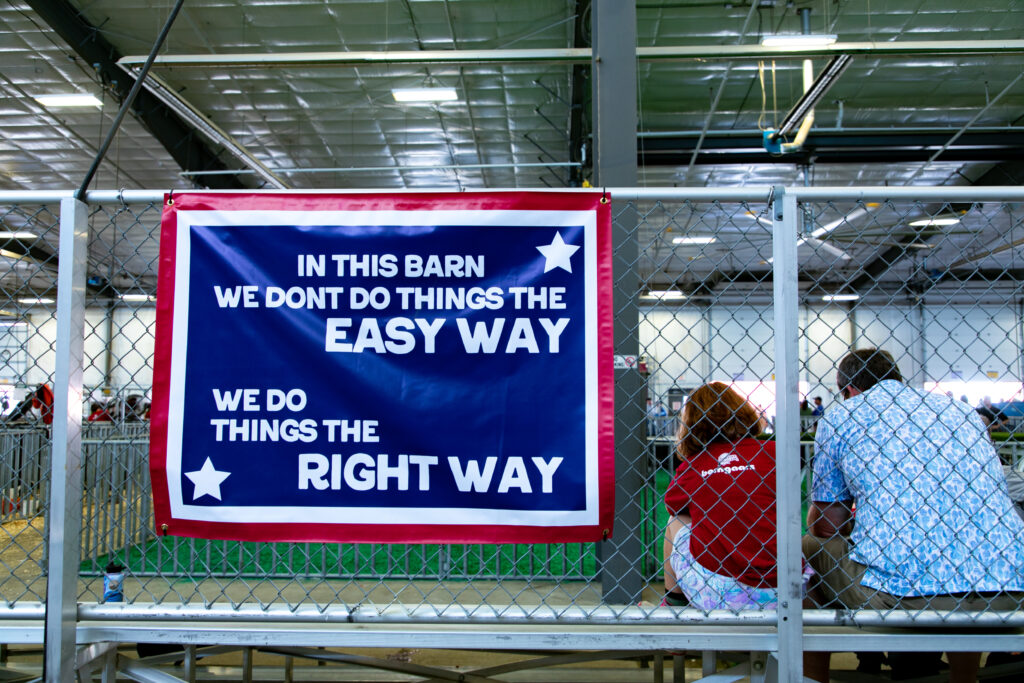
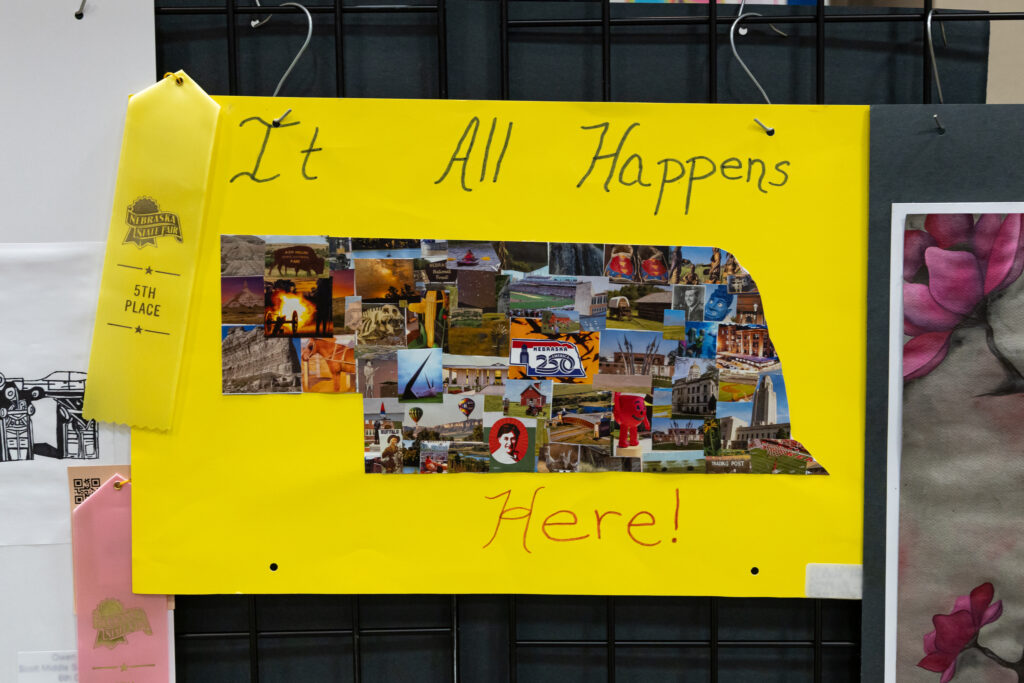
Inside the livestock barns, the air is thick with hay and manure. Industrial fans run overhead while cattle and goats make noise from their pens. Families sit in folding chairs beside their animals, some eating snacks and some watching a portable television showing high school football. A few people nap in their chairs between events. Kids in dark red 4-H shirts move through the aisles, the words “It all happens here!” printed across the back. For the kids in these barns, the shirts are not exactly exaggerating.
One of the signs in the barn reads, “Stay humble, hustle hard.”
Daryl Nelson, a cattle farmer from Saline County, watches his six-year-old grandson work nearby. The boy picks up a 48-inch shovel to help clean the pen, the handle taller than his small frame.
“Don’t just stand around,” Nelson says, jokingly.
The boy gets back to work, and Nelson watches him with the kind of attention that suggests he has heard that line before.
For many of the young people showing livestock at the Nebraska State Fair, the competition is only one part of the experience. The fair works with Nebraska 4-H and Nebraska Future Farmers of America (FFA) to hold contests in beef, swine, sheep and goats, among other species.
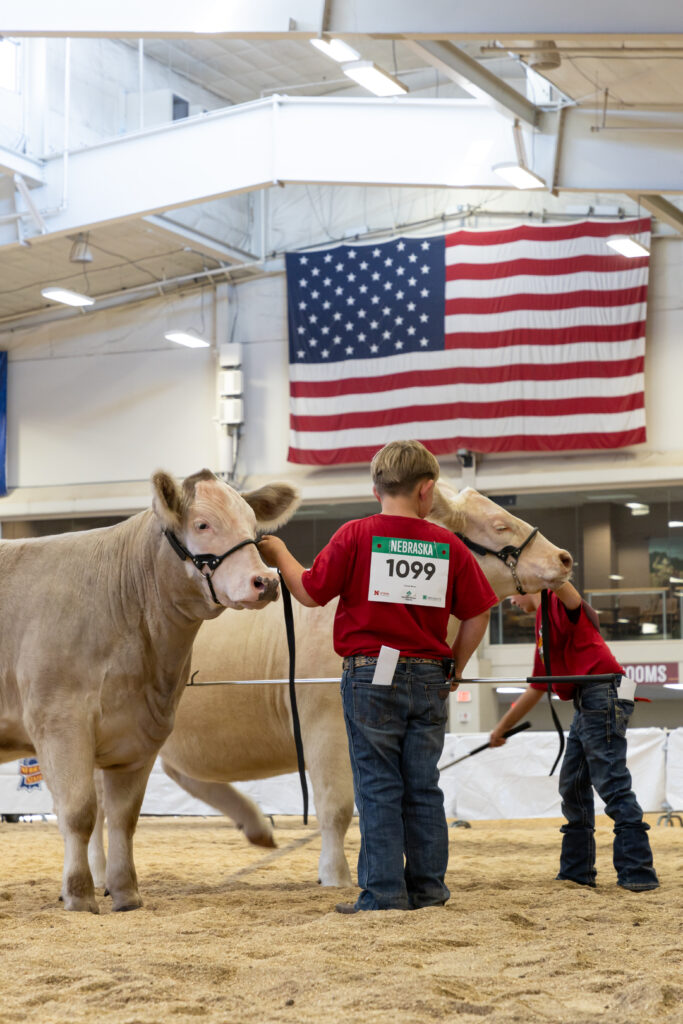
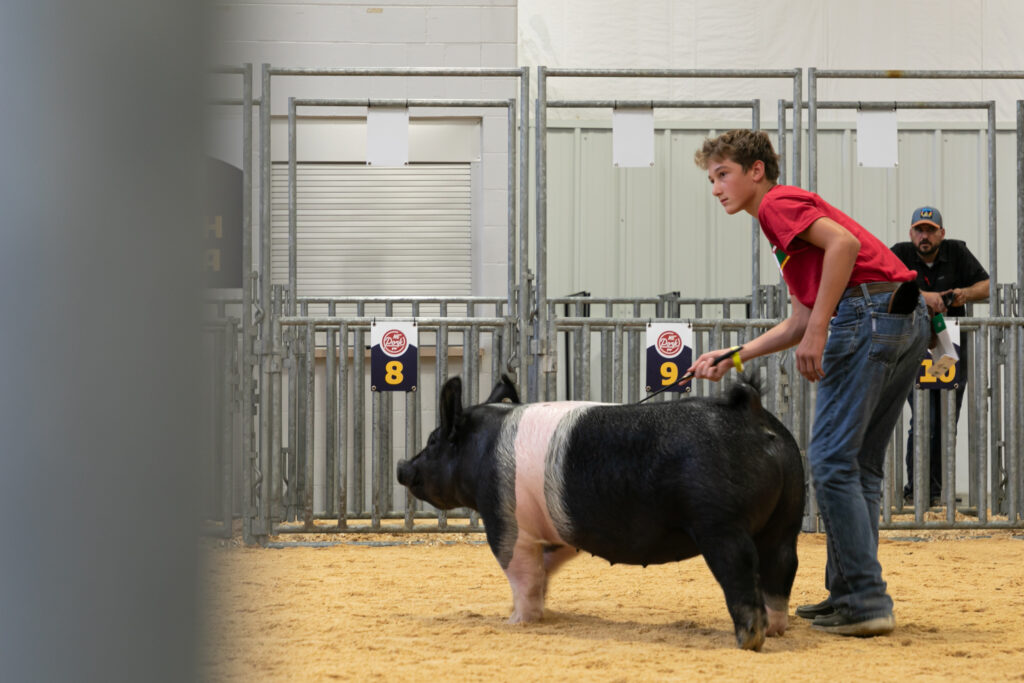
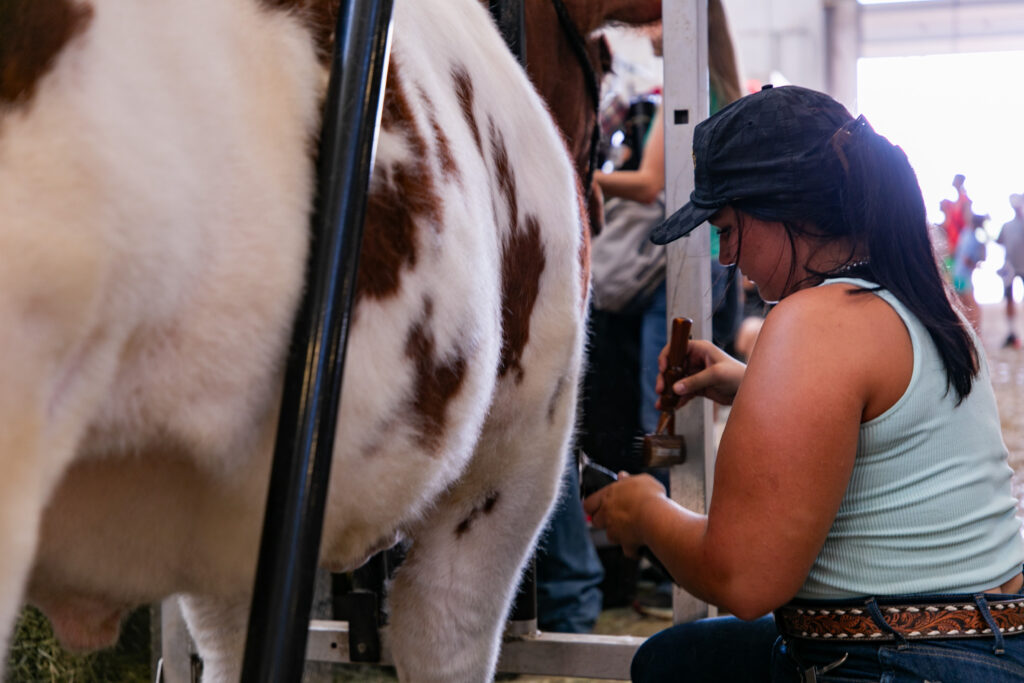
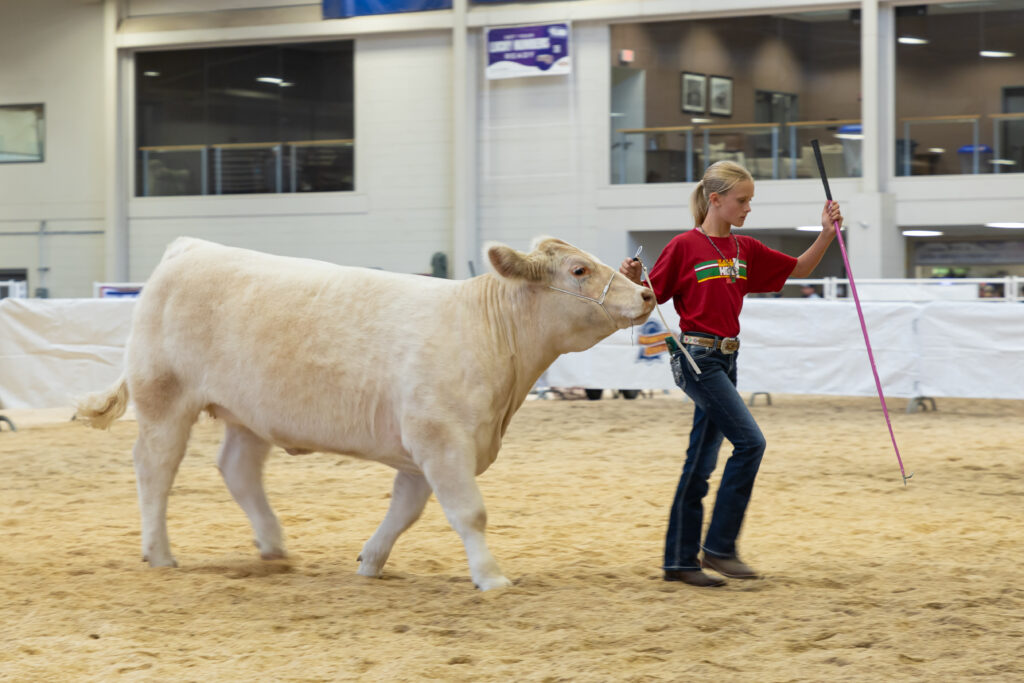
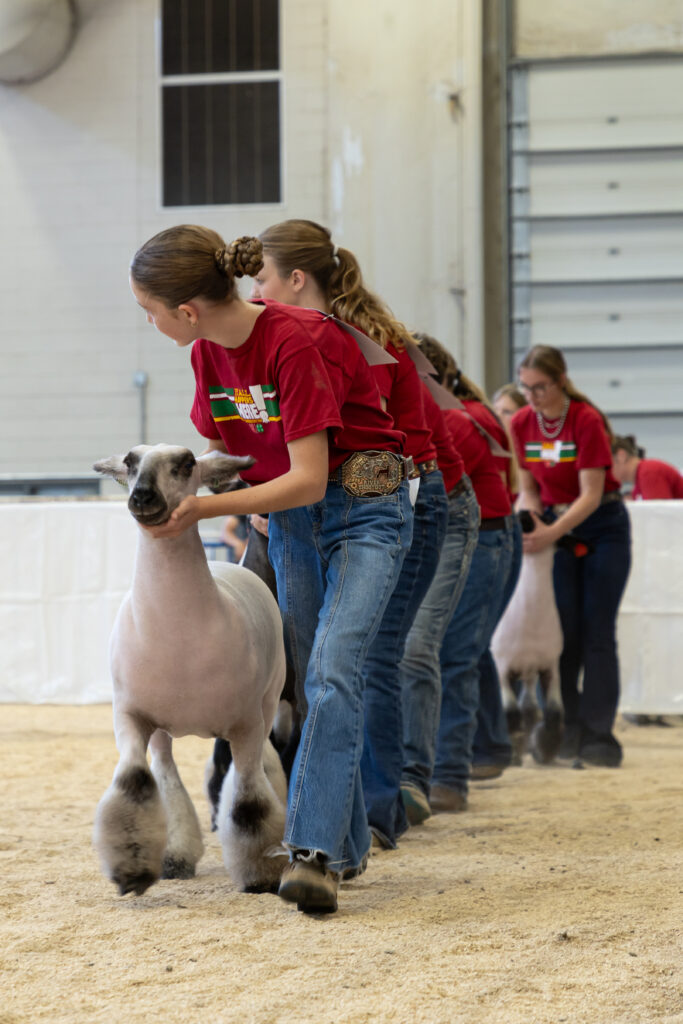
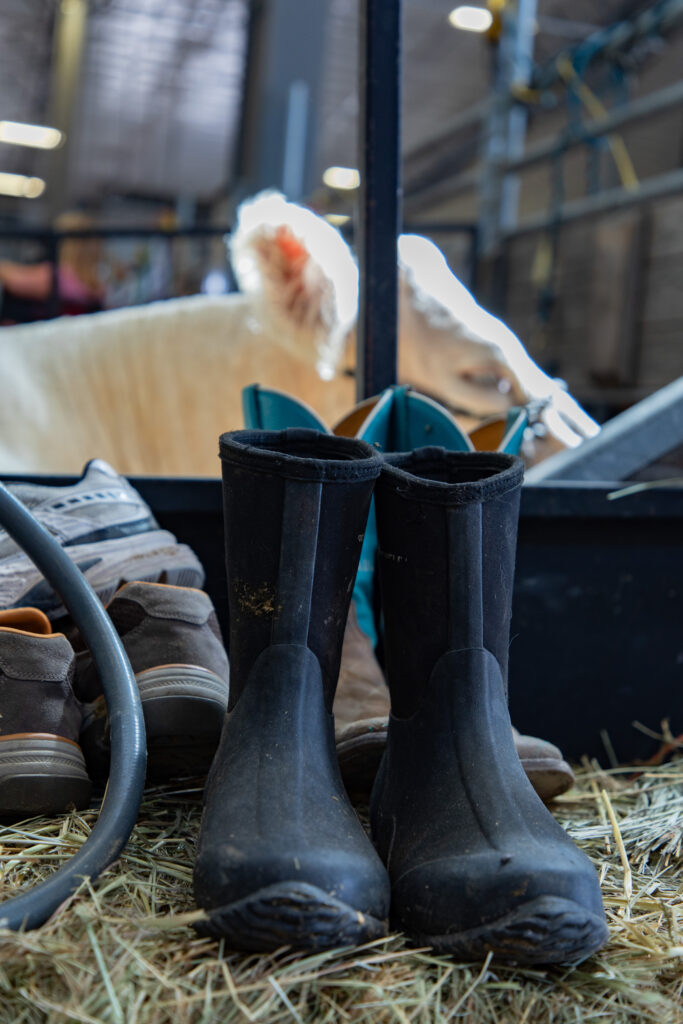
Exhibitors are automatically entered in the showmanship category for each livestock species they enter, with judges looking at the exhibitor’s preparation, poise and ability to handle the animal. Other classes focus on the animal itself, depending on whether it is being shown as a market or breeding animal.
Zaia Hansen, a junior from Hamilton County, has been in 4-H since she was 12. She shows market steers and competes in showmanship. Preparing for the fair takes more than four hours of work each day, she said, and the routine demands attention long before she walks into the show ring.
“It’s a lot of commitment. You can’t have other distractions, otherwise you’re not going to have the outcome that you want,” Hansen said.
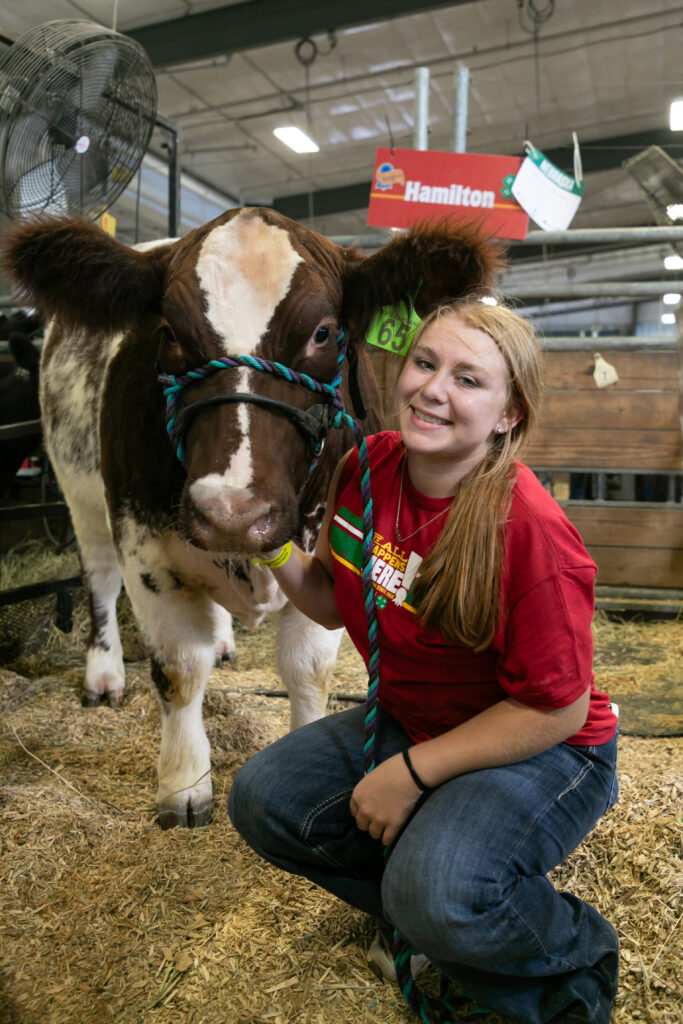
She also talks about the people she has met through 4-H, many of whom she sees only when they come together for events like the state fair.
“It’s a great opportunity to make friends from around the whole state of Nebraska,” she said.
For Aislynn Jensen, also a junior from Hamilton County, the livestock barns have become a family place. She started 4-H when she was 8 and has always shown cattle. She competes in showmanship, breeding and market classes, and now three of her four siblings have shown cattle. Her youngest sister started this year.
“This is probably the most exciting time of the summer,” she said.
Ryder Brabec remembers being the first person in his family to compete.
Brabec, a freshman at Northeast Community College, has shown pigs for 10 years. His parents did not show when they were growing up, although his father raised pigs and cattle. When Brabec expressed interest in competing, they went along with it.
“I told them I wanted to do it, and we kinda just took off running,” he said.
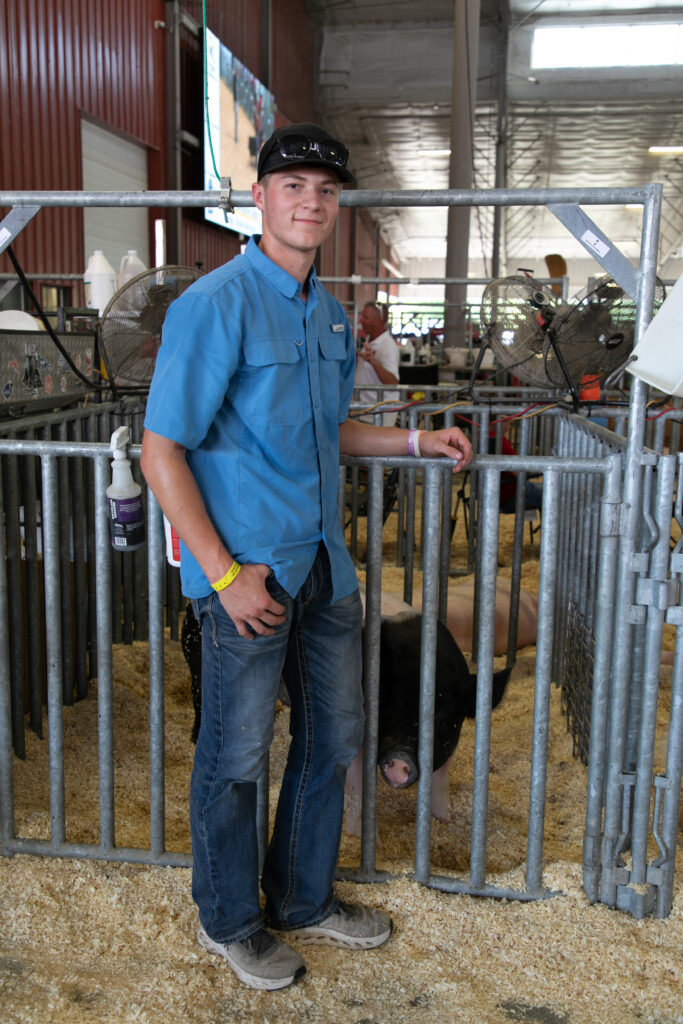
From the beginning, his parents gave him room to take ownership of his animals.
“Even early on, they pretty much let me handle it by myself. It’s been a great learning experience for me,” he said.
Now Brabec competes in commercial breeding gilt, market gilt and purebred breeding classes. He is studying animal science at Northeast and hopes to eventually run his own operation breeding show pigs.
He is also the oldest of four children. This year, his youngest brother won Senior Showman Champion. Brabec was proud of him.
“It takes a lot of dedication and hard work. Early mornings aren’t always fun, but I enjoy every minute of it,” he said.
Meredith Ruda’s work has taken her beyond showing one kind of animal.
Ruda, a sophomore at the University of Nebraska-Lincoln studying agricultural leadership and communication, grew up around cattle. Both of her grandparents own cattle, and she spent time at their farm before her family moved to a ranch when she was in fourth grade. That gave her the chance to begin showing her own animals.
She still wears a shiny gold belt buckle she won at the Dodge County Fair for the round robin show. When asked about it, she grins.
The round robin requires exhibitors to work with several kinds of livestock and demonstrate what they know about the animals. Ruda competed from county fairs to state fairs and then at national-level events, including the Oklahoma Cattlemen’s Congress in January. The experience has forced her to learn parts of animal science beyond simply leading a cow into a ring.
“It’s taught me to get out of my comfort zone. In the barn, there are certain things that are scary to do at first, but then I teach myself how to do them,” Ruda said. “It pushes me in a lot of ways.”
She also likes what happens when visitors ask questions about her work.
“I have the most fun talking to people who aren’t even familiar with the livestock world. People come up to ask about my cattle … and they might be from in-town and haven’t been to a show before,” she said. “It means so much when I get to educate others.”
The educational experience is not limited to the livestock barns.
Tucked inside a nicely air-conditioned room next to the Bosselman Conference Center, the Education Department offers another place for Nebraska students to bring something they have spent time learning or making. Inside the room are clay figures, artwork, writing, science projects and other schoolwork.
The Education Department invites students who completed kindergarten through 12th grade in spring 2026 to enter. Students can submit work in categories ranging from art, photography and poetry to history, science, penmanship and other academic competitions. Some entries are displayed and judged, while other events take place as live competitions or tests.
Deb Lawson, one of the Education Department superintendents, has worked with the department for four years. Before that, she taught dual-credit speech at Grand Island Senior High and judged the poetry recitation competition for 12 years.
Now, she moves through the exhibits with the familiarity of someone who has seen them year after year. She stops at a group of small clay pigs.
“I just love these. Look at their little ears!” she says.
Later, Lawson kneels beside a sixth grade art project and points toward the blue ribbon attached to it.
“I like seeing the faces of the students who come in, saying, ‘Wow, I won a blue ribbon! Mom, take a picture with me,’” she said. “It just warms my heart.”
The students’ recognition matters, but Lawson sees value in the work itself.
“It teaches creativity, it teaches perseverance … and not everybody wins, you know? So there is an element of sportsmanship, too,” she said.
One of the featured 2026 divisions is Warmth for Veterans, where students can make items such as quilts, blankets, pillows, hats, scarves or other gifts to donate to veterans. Many might gift their project to a grandparent that served, while others choose to donate to their local American Legion office.
“This is a wonderful project, because it teaches kids to care about something bigger than themselves,” Lawson said.
Lawson has watched teachers turn projects into class assignments, or individual students return year after year with subjects they care about. Homeschool families might bring in art that siblings crafted together. Some students come looking for a ribbon, while others simply enjoy seeing their work on display. That is part of what makes the fair different from a day spent walking through the midway. The students are not only there to see others’ work, but also to get their own small piece of the fair.
The State Fair gives Nebraska kids a place to show what they know how to do, whether that means handling an animal, answering a question or making something with their hands. The fairgrounds may be filled with things designed to entertain people, but if you stop and look closely, you’ll see kids still finding wonder in the simple things.